They Stopped Asking Your Age and Started Guessing It
Here's the deal: on August 18, OpenAI began a global rollout of ChatGPT for Teens, a separate experience for users aged 13 to 17. The rollout is expected to finish within two weeks.
The most important line in the announcement isn't in the feature list. It's the entry condition. If you tell ChatGPT you're 13-17, you land in teen mode — obviously. But you also land there if you don't tell it anything. An age prediction model decides whether an account "likely belongs to someone under 18," and routes it automatically. The birthday field you used to type garbage into no longer decides anything.
That's the exact spot where a decade of online minor-protection policy has quietly failed. Every service has had an "I am over 13" checkbox. Almost none of them verified it. OpenAI's workaround is to skip ID checks entirely and read behavioral signals instead — conversation topics, phrasing, usage patterns — and infer an age band from them.
False positives are guaranteed. Adults will get classified as teens, and their answers will suddenly get careful. OpenAI has an identity-verification path back to an adult account for that case. But the stated principle is unambiguous: when the signal is ambiguous, the system leans toward the safer classification. Toward teen.
How OpenAI Ended Up Here
ChatGPT shipped in late 2022, and teenagers started using it immediately. Homework, career advice, emotional venting — the use cases were wide. The problem was that the product was never designed with that user in mind. A conversational model built for adults simply had minors inside it.
OpenAI began closing that gap in the second half of 2025. In late September it shipped parental controls for the first time: link a parent account to a teen account, restrict features, and get notified when serious risk signals appear. In November it published the Teen Safety Blueprint, a policy framework built with organizations including Common Sense Media, laying out what an AI service aimed at young people ought to guarantee.
On July 13, 2026, parental controls got a major expansion — that's when notifications for parents whose teen's account gets banned for violent behavior were added. The August 18 announcement is the endpoint of that arc. OpenAI moved from bolting individual features onto the adult product to splitting off a distinct product experience entirely.
The pressure behind that shift is legal. Multiple suits are active, including a Florida case naming both OpenAI and Sam Altman personally, alleging that ChatGPT conversations contributed to teen self-harm and violent incidents. Regulatory pressure is stacking on top. Several US states and the EU are running parallel legislative efforts on AI services for minors, and a lot of those drafts put age verification in the operative clause.
The corporate math is simple. Writing your own standard before regulators write one is cheaper than having someone else's standard grafted onto you afterward. And while litigation is live, being able to point at a shipped mitigation is worth something.
What Actually Gets Blocked, and What Opens Up
| Area | Standard ChatGPT | ChatGPT for Teens |
|---|---|---|
| Entry | Self-declared birthdate | Self-declaration + automatic routing by age prediction |
| Self-harm / suicide | Crisis resources, conversation continues | Responses restricted more aggressively |
| Romantic / sexual chat | Adult-tier filter | Romantic and sexual roleplay blocked |
| Anthropomorphism | Model may reference feelings | Model won't act as if it has feelings or consciousness |
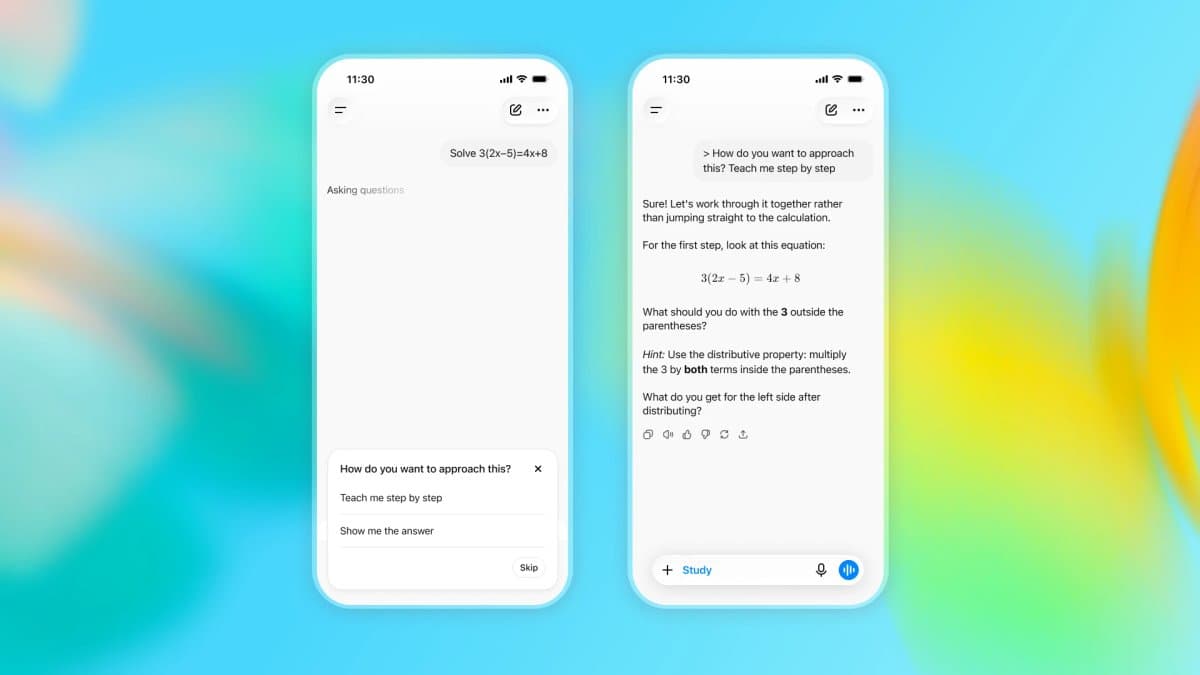
| Study help | Gives the answer | Study Mode: guiding questions, step-by-step |
| Cheating | No specific handling | Homework reminder, redirect into Study Mode |
| Session length | No limit | Break reminders; parents can set Quiet Hours |
| Image uploads | General filter | Warnings on sensitive image uploads |
The restricted list covers self-harm and suicide, disordered eating, violence, dangerous activities and substances, sexually explicit or graphic content — and requests to keep secrets about unsafe behavior. That last one is the interesting addition. The pattern where a kid discloses something dangerous and then asks the model not to tell anyone is now explicitly something the model won't play along with.
The anthropomorphism limits are new too. The model is constrained from expressing affection or answering as though it experiences feelings or has consciousness. For adult users, "it feels like a friend" is arguably the product. For someone in an emotionally volatile stage of life, OpenAI's judgment is that the same quality builds dependency.
What opens up is learning. Study Mode replaces the answer with guiding questions and step-by-step scaffolding, plus quizzes and learning visualizations. Parents can lock it on as the default, and can set Quiet Hours during which ChatGPT is unavailable at all. If the system reads an exchange as an attempt to have homework done outright, a reminder appears and steers the session into Study Mode.
Scale gives that some weight. ChatGPT's weekly active user base sits somewhere around 800 million, and OpenAI has never published what share of that is minors. Multiple surveys of US teens, though, put the share who have used generative AI for schoolwork above half. If automatic routing works as described, the response policy for tens of millions of accounts changes effectively overnight. Staging the rollout across two weeks rather than flipping it at once looks like a direct consequence of that scale.
There's an AI literacy component as well. OpenAI says it worked with CodeAI on in-product material about how AI systems work and how to interrogate their answers.
Who Gets What Out of This
OpenAI gets regulatory leverage. When minor-protection legislation gets drafted, the company can now say it already operates age prediction and a separate product experience — and push its own implementation as the de facto industry template. In active litigation, a shipped mitigation is a defensive fact.
Parents get controls that actually bind. Until now the practical option was confiscating the device. Now there are Quiet Hours, a locked Study Mode default, and distress notifications. The catch: all of it depends on the teen consenting to link accounts. Refuse the link, spin up a fresh account, and the parental layer is gone — at which point age prediction is the only thing left standing.
Schools get an ambiguous win. Study Mode is the direction teachers have been asking for: a tool that interrogates process instead of handing over output. But the cheating detection lives inside ChatGPT. A student who opens a different AI tool is outside it entirely.
Advertisers and publishers get predictability. OpenAI started placing ads in ChatGPT this year, and cleanly segregated minor accounts make ad targeting far easier to defend. Rules on advertising to children vary by jurisdiction and carry heavy penalties, so having age split at the account layer is a business asset in its own right. This announcement is a safety measure and an infrastructure cleanup at the same time.
Teens themselves get less, honestly. This is a subtraction, not an addition. Expect workaround attempts to avoid misclassification into the restricted tier — that conversation is already running in communities. Building age prediction on behavior rather than declarations is precisely meant to make those workarounds harder, but it isn't airtight.
What Happened the Last Few Times Someone Tried This
YouTube Kids is the oldest reference point. Google split it into a separate app in 2015 and still runs it. Teenagers don't use it. The real user base tops out around early elementary school; everyone older migrates to regular YouTube. It's a clean demonstration of the structural limit of the separate-product strategy — which is likely why OpenAI built teen mode as a mode inside ChatGPT rather than a standalone app.
Instagram Teen Accounts is the closer comparison. Meta started auto-enrolling minor accounts into a restricted mode in 2024 and layered age estimation on in 2025. Two lessons came out of it. First, automatic enrollment genuinely works — far more accounts landed in protected settings than under self-declaration. Second, false-positive complaints are not a rounding error; adults hitting unexpected restrictions was a steady stream.
Apple Screen Time teaches a different lesson. The feature set was strong and the bypasses were trivial. Kids shared workarounds with each other and the effectiveness eroded. That's what happens when parental controls depend on the child's cooperation to stay in place.
Character.AI is the cautionary version. After a teen suicide case and the litigation that followed, the company moved in late 2025 to effectively cut off open-ended conversation for under-18 users. Regulation and lawsuits arrived first; the product changed second; the cost was severe. That sequence is the reason OpenAI is moving now.
One pattern runs through all four: minor-protection features almost always ship after something has already gone wrong. YouTube Kids, Instagram Teen Accounts, Character.AI's lockdown — all reactive. OpenAI's announcement, arriving mid-litigation, isn't an exception either. What is a step beyond the prior art is making age prediction the default entry path. This is the first large-scale implementation that doesn't rely on self-declaration.
How Rivals Play This
Google is already in through a different door: Gemini layered onto education accounts. Sit on top of a school-managed identity system and the age verification problem never arises, because the school already knows who the student is. That's a structurally different starting point from OpenAI's consumer accounts, and in the education market it favors Google.
Meta has run age estimation in production longer than anyone. Applying the same logic to the AI assistants embedded in Instagram and WhatsApp is a matter of scheduling, not research. The complication is trust — Meta has spent down a lot of credibility on minor safety, so identical measures get received differently.
Anthropic is under less pressure by virtue of its mix. Claude's center of gravity is developers and enterprises, so minor exposure is comparatively low. If regulation lands on "all general-purpose conversational AI," though, exemption is unlikely.
Chinese open-weight models are the awkward variable. A model running locally has no age prediction, no parental controls, and no blocklist. If regulation tightens only around US commercial services, technically capable teens can migrate toward the option with no guardrails at all. That's the structural hole this announcement doesn't close.
So What Actually Changes
If you're a parent of a teen, start by linking accounts in ChatGPT settings. Automatic routing happens regardless, but Quiet Hours and a locked Study Mode default require the link. And know the boundary: this covers ChatGPT, not other AI services, browser-based tools, or locally run models.
If you're a teacher, Study Mode makes a different assignment design viable. Output-only assignments remain defenseless, but requiring the reasoning trail — submitted as a conversation log — is now a real option. The premise that you can't control which tool a student opens still holds.
If you build AI products, treat this as the emerging baseline. Age prediction, age-tiered response policy, and parental controls are three axes with a high probability of appearing verbatim in future regulatory text. If you run a service with minors on it today, the first thing to check is whether you're logging any age signal at all.
If you work in policy, the thing to press on is verifiability. Accuracy, false-positive rate, and appeal turnaround time for the age prediction model have not been published. Self-regulation only functions when those numbers can be audited from outside.
If you're just a user, know that misclassification is possible. If your answers suddenly got cautious, you may have been routed into the teen tier; the Help Center documents the identity-verification path back.
🥄 Three Things You're Probably Wondering
— What happens if age prediction wrongly flags me as a teen? Your answer range narrows and certain topics get blocked. OpenAI provides an identity-verification route back to an adult account, but has not published accuracy figures or turnaround times. How often this actually misfires is something we'll only learn from use.
— Can't my kid just make a new account? For parental controls, yes — break the link and settings like Quiet Hours stop applying. Age prediction is different, since a fresh account still gets read on conversational patterns. So it's not a clean bypass. Switching to a different AI service, on the other hand, disables all of this at once.
— Does this make the lawsuits go away? Too early to say. The active cases mostly concern conversations that predate these measures, so there's no retroactive effect. It may narrow forward-looking liability, and it clearly strengthens OpenAI's position in the regulatory conversation.
References
- ChatGPT for Teens (OpenAI, 2026-08-18) — the primary source for the 13-17 scope, automatic routing via age prediction, the blocked categories, Study Mode, Quiet Hours, and the two-week rollout.
- OpenAI launches a safer ChatGPT for teens, years after teens started using it (TechCrunch, 2026-08-18) — homework-cheating reminders, the CodeAI partnership, and the litigation backdrop including the Florida case.
- OpenAI debuts ChatGPT for Teens (Axios, 2026-08-18) — a tight read on the self-harm and sexual-content restrictions and the regulatory timeline.
- Our approach to age prediction (OpenAI) — the design rationale for inferring age from behavior instead of ID, including the stated bias toward the safer classification.
- Introducing the Teen Safety Blueprint (OpenAI, 2025-11) — the policy skeleton this product was built on, developed with Common Sense Media and others.
- Updating our Model Spec with teen protections (OpenAI) — how the anthropomorphism limits and high-risk topic handling were written into the Model Spec.
- Age prediction in ChatGPT (OpenAI Help Center) — the documented path for recovering an adult account after a misclassification.
- OpenAI launches ChatGPT for Teens with new safety guardrails (Euronews, 2026-08-18) — coverage framing the launch against European regulatory pressure.
Numbers and criteria are as of announcement and may change.