Priced at 150.8 Yuan. Opened at 1,100.
Here's the deal: on August 19, Unitree — formally Yushu Technology — listed on the Shanghai Stock Exchange's STAR Market under ticker 688836. What happened in the first session was this.
The IPO priced at 150.8 yuan. The stock opened at 1,100 yuan. Up 629%, the largest first-day gain for any Chinese listing this year. Intraday market cap reached roughly 445 billion yuan, about $66 billion.
By the close it had pared back to 845 yuan — still 460% above the offer price. That's why outlets report different numbers: Caixin and SCMP use the 629% open, CNBC computed 542% against the close. Either way, this is not what functioning price discovery looks like.
The raise came to 6.1 billion yuan (about $905 million), well past the original 4.2 billion target. And in the book-building stage, demand exceeded supply by more than 8,000 times — a STAR Market record.
The Cast: Wang Xingxing, DeepSeek, and the State
Unitree was founded in 2016 by Wang Xingxing. It made its name on quadrupeds — robot dogs — before moving into humanoids. What made the company famous wasn't a paper; it was video. Robots doing backflips, robots sparring, robots dancing in formation on the Spring Festival Gala broadcast. It's a rare case of a robotics company achieving consumer-brand recognition, and a large share of the subscription frenzy traces back to that.
Its pricing is distinctive too. Unitree has consistently sold well below competitors — at price points research labs and individual developers can actually clear — which made it the de facto standard platform in academia and the robotics community. While US humanoid startups quoted in the hundreds of thousands of dollars, Unitree quoted a different order of magnitude.
The investor roster shows the listing's political weight. Early backers include Meituan, HSG (formerly Sequoia China), and Xiaomi. Meituan holds 9.6%.
The strategic placement brought more interesting names. DeepSeek invested about 141 million yuan, bound by a three-year lockup. That's not a financial position. DeepSeek agreed to co-develop AI models and embodied intelligence technology with Unitree — China's leading language model company and its leading robot hardware company, joined at the cap table.
Tencent joined. So did state-backed giants: China National Petroleum, China Southern Power Grid, China Telecom, Citic Securities, and the National Council for Social Security Fund. State capital participated heavily in the strategic allocation — a signal that this listing isn't merely a capital markets event.
The Numbers
| Item | Value |
|---|---|
| Ticker | 688836.SH (Shanghai STAR Market) |
| Listing date | 2026-08-19 |
| Offer price | 150.80 yuan |
| Open | 1,100 yuan (+629%) |
| Close | 845 yuan (+460%) |
| Raised | 6.1 billion yuan (~$905M) |
| Original target | 4.2 billion yuan |
| Shares outstanding post-issue | 404 million |
| Market cap at offer price | ~60.99 billion yuan (~$9B) |
| Intraday peak market cap | ~445 billion yuan (~$66B) |
| Oversubscription | 8,000x+ (STAR Market record) |
| DeepSeek stake | ~141M yuan, three-year lockup |
The most important number here is actually 60.99 billion yuan — the market cap at the offer price, roughly $9 billion. That's what CNBC reported when pricing settled on August 6.
Then it touched $66 billion intraday. The company's valuation multiplied more than sevenfold in thirteen days. Nothing about the business changed. Same revenue, same products, same customers. The only change was that you could buy the stock.
That's partly a structural feature of the STAR Market, which has no daily price limit for the first five trading sessions. With limited free float and heavy retail demand, nothing caps where price goes. The 8,000x oversubscription is that imbalance stated numerically.
Why this company specifically
Three factors compounded into that demand.
First, recognition. Thanks to those videos, Unitree is one of very few robotics companies ordinary Chinese investors can name. Retail subscription piles into names people know, and this company has put robots on the Spring Festival Gala stage.
Second, scarcity. There was effectively no listed pure-play on humanoid robots. Tesla is a car company; Japanese robotics firms sell industrial arms. Demand to "invest in humanoids" had no vessel until this one opened.
Third, the policy narrative. China has explicitly designated embodied intelligence and humanoids as next-generation strategic industries. State-owned enterprises and the social security fund entering the strategic allocation re-confirmed that signal to the market. Retail money chasing policy-favored names is an old pattern in this market.
Who Gets What
Wang Xingxing and early investors are the biggest winners. Meituan (9.6%), HSG, and Xiaomi hold enormous paper gains. Strategic allocation carries lockups, so nothing converts to cash immediately.
DeepSeek's position is the most interesting. 141 million yuan is not large money for DeepSeek. The point is the three-year lockup paired with a joint technology development agreement. A language model company taking equity in a robot body is a declaration of direction toward embodied intelligence — a judgment that software alone doesn't reach certain places, resolved by binding to the best hardware maker rather than building the body itself.
Tencent secured robotics exposure through the strategic allocation. The simulation and rendering assets it accumulated in gaming and cloud overlap with robot training environments, giving it a synergy angle distinct from DeepSeek's.
The Chinese government wins on several layers. State enterprises and the social security fund participated in the strategic allocation, so they share the upside directly, while the state also gets the narrative that Chinese deep tech receives world-class valuations on domestic exchanges. It demonstrates the STAR Market as an alternative for Chinese firms that can't or won't list in the US.
Chinese robotics as a whole gets capital. Unitree's valuation is now the sector's reference point — every company preparing a listing or running a private round will be priced against it.
Carrying the risk are retail buyers at the open. Anyone who bought at 1,100 was already down 23% at the 845 close. What happens to buyers at day-one highs is documented repeatedly across market history.
Precedents: What Day-One Spikes Leave Behind
SMIC's 2020 STAR Market listing is the closest comparison. Strategic national industry, state capital participation, a day-one spike, and years of subsequent adjustment. It rose over 200% on debut and spent a long time below that price afterward. Strategic importance and share performance turn out to be different questions.
Rivian (2021) is worth holding alongside it. With almost no revenue, its post-listing market cap passed $100 billion and overtook Ford and GM. Then it fell more than 90% over several years. The problem wasn't a bad company — it was pricing all of the future into the present. Given continued uncertainty about when humanoids commercialize at scale, Unitree carries structurally similar exposure.
On the positive side, CATL (2018) listed in Shenzhen seven years after founding, hit limit-up on day one, and then grew into the valuation. EV battery demand genuinely exploded and CATL captured it.
The critical difference is that when CATL listed, the EV market already existed. People argued about growth rates, not existence. Humanoid robots aren't there. Nobody has demonstrated at scale that a humanoid beats existing methods economically in factory automation, logistics, or services. A substantial share of Unitree's revenue still comes from research, education, and entertainment.
There's also the 2021 warehouse automation boom to remember. When pandemic-era logistics expectations inflated, multiple robotics companies took rich valuations and most corrected once the special demand ended. Robot demand responds sharply to labor costs and interest rates, and both swing on multi-year cycles. Whether today's humanoid enthusiasm is a structural shift or a cyclical phase is not yet separable.
Competitor Counterplay
Tesla's Optimus is the most common comparison. Tesla is building toward deployment in its own factories, leaning on vertical integration and captive demand. Unitree runs the opposite play — build cheap, sell wide, capture the ecosystem first. The matchup rhymes with Android versus iPhone.
US startups like Figure AI, Agility Robotics, and Apptronik get repriced by comparison. Forbes ran the headline "Unitree IPO's Massive 629% Pop Makes Agility Robotics Look Super Cheap." That's a new card for private round negotiations — and simultaneously a view of Chinese competitors pulling ahead on capital access.
Chinese rivals — UBTech, Agibot, Fourier — immediately get wider funding windows as Unitree's valuation lifts the reference point. They also inherit more pressure to explain the gap.
Nvidia and the semiconductor sector benefit indirectly. Humanoids demand substantial onboard inference and heavy simulation compute during training, so better capital access for robot makers eventually flows into silicon. In China, though, export controls push domestic chip adoption in parallel, so the benefit doesn't route cleanly to US vendors.
Component suppliers are the quiet winners. Harmonic drives, precision reducers, actuators, and force sensors capture robot-boom revenue first — selling picks in a gold rush. The contest between incumbents like Harmonic Drive Systems and Nabtesco and Chinese domestic substitutes gets decided here.
What Actually Changes for You
If you're a robotics founder: the funding environment clearly improved. This listing proved in public markets that robot companies can command large valuations, and investor comparables went up. The sharper question came with it: what makes you better than Unitree?
If you're deploying robots: the listing is good news. Much of the 6.1 billion yuan goes to capacity expansion and R&D, so expect better supply stability and product improvement. Watch whether the valuation jump changes pricing policy, though — Unitree's greatest strength was price, and public-market margin pressure can reshape that strategy.
If you know manufacturing floors: the real validation point isn't valuation, it's uptime. Putting humanoids into industrial settings requires hours of continuous operation without falling, next-day parts availability, and safety certification. Unitree's disclosed products don't clearly meet all three at industrial standard yet. That's not a claim the company can't get there — just that the stage remains ahead.
If you're an investor: entering now means entering after a day-one melt-up. It's already down 23% from the 1,100 open to the 845 close, and the STAR Market has no price limit for five sessions. Three things to check: the split between research/entertainment revenue and genuine industrial demand, when the DeepSeek co-development produces shipping product, and the lockup release schedule.
If you follow AI: DeepSeek's stake is the most meaningful signal here. A language model company committing both equity and technology to robot hardware indicates Chinese AI moving past the software stage toward embodied intelligence. Given that the OpenAI-Figure partnership in the US broke down once, this pairing is a useful contrast case to watch.
If you're just reading the news: the summary is that backflip videos turned into a $66 billion valuation. Whether that valuation is justified will be answered over the next few years by how many robots Unitree sells and to whom.
🥄 Three Things You're Probably Wondering
— Isn't 629% obviously a bubble? It's hard to call it functioning price discovery. An 8,000x oversubscription means supply and demand were completely mismatched, and the STAR Market has no price limit for five days. Whether it's a bubble depends on whether results catch up to the price. Too early to call.
— Why would DeepSeek invest in a robot company? The 141 million yuan isn't much money to DeepSeek. The substance is the three-year lockup paired with a joint agreement on AI models and embodied intelligence. Language models alone can't reach physical-world data, and rather than build a body, DeepSeek bound itself to the best hardware maker.
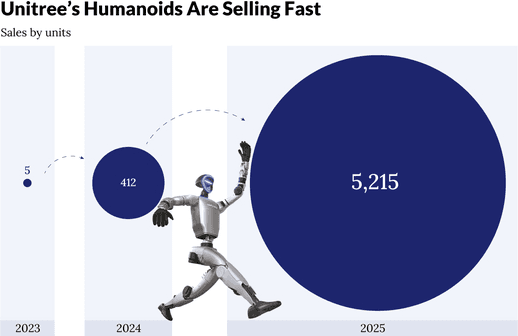
— Are Unitree robots actually selling? Yes. But the primary customers are still labs, universities, and entertainment or exhibition use. Large-scale commercial deployment replacing human work in factories or logistics hasn't happened. The $66 billion figure reflects expectation of that arrival, not current revenue.
References
- Caixin Global — Chinese Robot Maker Unitree Soars 629% in Shanghai Debut (2026-08-19)
- SCMP — Unitree Robotics surges 629% to US$66 billion valuation in Shanghai share debut (2026-08-19)
- CNBC — China's backflipping robot maker Unitree pops 542% in Shanghai debut (2026-08-19)
- Caixin Global — Unitree's IPO Prospectus Reveals Heavyweight Tech Backers (2026-08-05)
- Yushu Technology Co., Ltd. IPO Prospectus — Full English Translation
- SCMP — Backed by DeepSeek, Unitree IPO tests investor appetite for China's AI robotics boom
- CNBC — Chinese humanoid robot maker Unitree prices IPO at $9 billion valuation (2026-08-06)
Numbers and criteria are as of announcement and may change. Investment calls are yours to make!