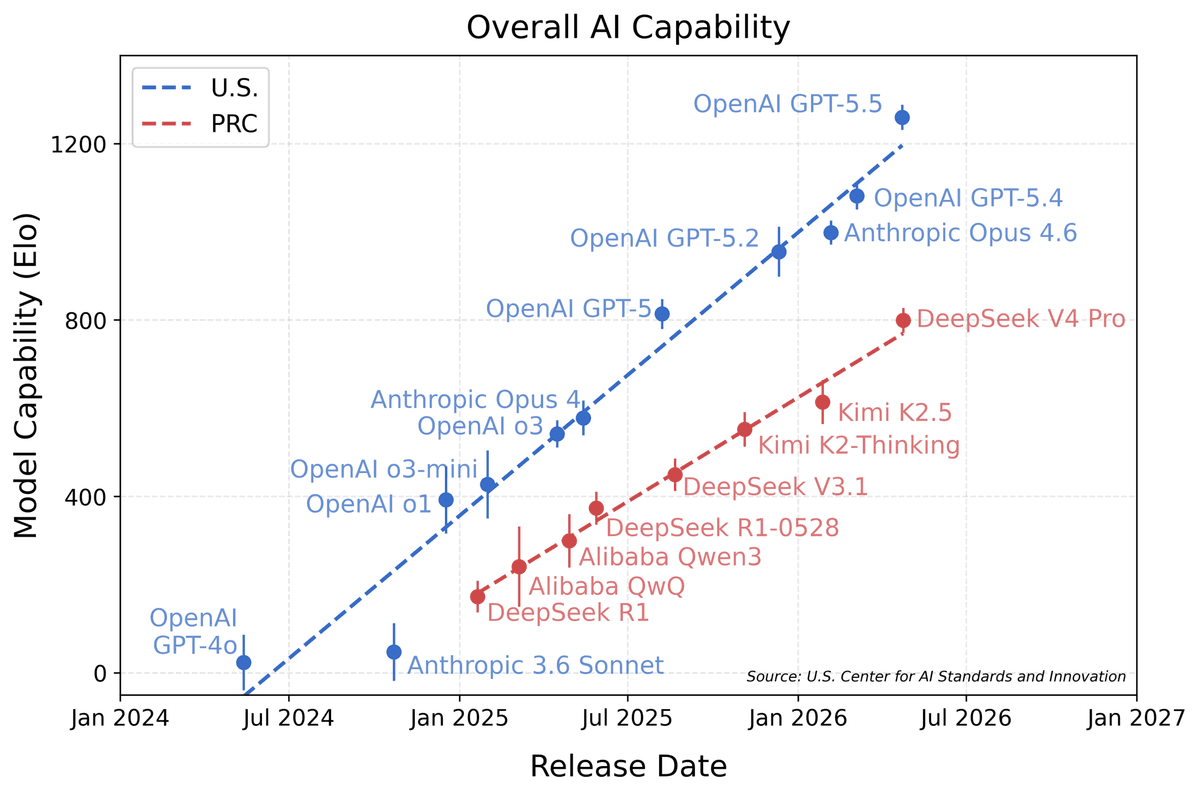
They bolted on eyes without touching the brain, and won three benchmarks
Here's the deal: on August 21, DeepSeek released its first multimodal model. The ID is deepseek-v4-flash-vision-exp. That exp suffix is doing real work — this is an experimental model, and it shipped as an API endpoint with no open weights attached.
What's interesting is how DeepSeek framed it. Not "we built a new model" but "we added image input to V4-Flash." And they backed that framing with a specific claim: pure-text capability — agentic behavior, reasoning, world knowledge — stays on par with the existing V4-Flash.
That matters more than it sounds. Bolting multimodality onto a text model has historically cost you something. You add a vision encoder, run image-text alignment training, and the coding and math you were good at gets subtly duller. It's a tax almost everyone has paid. DeepSeek is claiming they didn't.
And on vision-dependent agent benchmarks the story gets better. DeepSeek said the model makes a "major leap" over V4-Flash and brings multimodal agent performance close to Opus 4.8. But look at the actual numbers and "close" undersells it — on three benchmarks it's ahead.
Who's who — DeepSeek, the Flash line, and Opus 4.8
DeepSeek needs a little context. It's a Hangzhou-based AI lab that spun out of the hedge fund High-Flyer, a lineage that follows it everywhere. It rattled the industry with R1 in early 2025 and has never let go of its core position: frontier-adjacent performance at a fraction of the price. One thing it had never shipped, until now, was a multimodal model.
V4-Flash is DeepSeek's lightweight, high-throughput line. Not the flagship — this is the model built to run fast and cheap at volume. The fact that DeepSeek attached its first vision capability to Flash rather than the flagship is not an accident. Vision makes money almost entirely in bulk: thousands of screenshots, tens of thousands of scanned pages, one frame captured at every step of a browser-automation loop. What you need there isn't peak intelligence. It's a unit cost you can survive.
Opus 4.8 is Anthropic's top-tier model, and DeepSeek chose it as the comparison. That choice is itself the message. Putting your lightweight model on the same chart as a competitor's flagship is a way of saying "our Flash fights your Opus" without having to say it.
If this feels familiar, it should. DeepSeek's playbook hasn't changed since R1: don't chase the very top of the performance curve, reproduce something near the top for dramatically less money, and let the price sheet do the arguing.
There's a new wrinkle this time. DeepSeek didn't build multimodality as a separate model — it extended an existing one. For users that means migration cost is close to zero. Keep your V4-Flash prompts and tool definitions, swap the model ID, and images work. The company says it supports Chat Completions, Messages, and Responses API shapes, so whether your codebase is written Anthropic-style or OpenAI-style, you keep the shape you have. The biggest barrier to evaluating a new model is usually "do I have to rewrite everything," and that barrier is gone.
Reading the benchmark table honestly
Here's what was published:
| Benchmark | DeepSeek-V4-Flash-Vision-Exp | Opus 4.8 | Delta |
|---|---|---|---|
| DeepSWE | ahead | — | +1.3 |
| Agents' Last Exam | ahead | — | +1.6 |
| ZeroBench | ahead | — | +1.0 |
| ApexBench | 36.5 | 39.4 | −2.9 |
| NL2Repo | 57.7 | 69.7 | −12.0 |
Read that honestly and here's what you get. The three DeepSeek wins are one to two points each. That's inside the range where benchmark noise lives, so "definitively better" is too strong a claim. Meanwhile one of the two losses, NL2Repo, is a 12-point gap. That's not noise. That's a capability difference.
Look at what NL2Repo measures and the shape of the gap becomes legible. It asks a model to produce repository-scale code from a natural-language requirement — multiple files, dependencies, project structure, all coherent at once. It rewards long-horizon planning. And that's exactly where DeepSeek is weakest here: it has caught up on short, local judgments while sitting 12 points behind on long, structural work.
ZeroBench, one of the wins, tests something different. It collects visual reasoning problems that humans find easy and models find unreasonably hard. Coming out ahead there says the raw perception is solid — the model actually reads what's on the screen.
Net: this thing sees well and plans-while-seeing less well. DeepSeek stamped exp on the name, which is its own admission that the work isn't finished.
One more caveat worth naming. What DeepSeek published was a benchmark comparison image. The release note doesn't include the full evaluation protocol or reproduction code. We can't see the prompts, the number of runs averaged, or whether tool use was permitted. A one-to-two-point margin only means something once those conditions are public. So the honest reading of the table isn't "DeepSeek won" — it's "DeepSeek is in the ring." That's newsworthy on its own. Anything more is overreading.
The image spec has some sharp edges
The official Vision guide is unusually specific. Supported formats are JPEG, PNG, GIF, and WebP. A single request takes up to 600 images. Without the Files API you get 64 MiB total; counting Files API uploads, that ceiling rises to 200 MiB. Individual images cap at 32 MiB via base64 or URL, 64 MiB through the Files API. External URLs can't exceed 8,192 characters.
There's a trap in the resolution rules. The per-side maximum is 8,192 pixels — but put 15 or more images in one request and that ceiling drops to 4,096. If you're batching scanned documents full of small type, you can slide under that threshold and watch accuracy quietly degrade without any error. Keeping batches under 15 images is the safe default.
Billing works as described: up to 384 tokens per image, with the system auto-resizing to roughly 800×800 to hold that ceiling. The design buys predictability. Whether the original is 4K or 1080p, the token ceiling on your invoice is the same. The flip side is that work requiring fine detail — reading small labels off a high-resolution schematic, say — can lose information to that resize. Pick your use cases accordingly.
Who actually gains here
DeepSeek gains category entry. Until this week there was an entire class of workload it simply couldn't serve: agents that need to look at a screen, document-image pipelines, UI automation. That door is open now. It doesn't need to be the best. Adding one viable option changes the shape of every pricing negotiation in the category.
Developers gain unit economics. Images convert to at most 384 tokens each, billed at V4-Flash text rates, with automatic resizing enforcing the ceiling. In practice that means processing a million images produces a bill that grows predictably and linearly. Compare that to tiling high-resolution images into exploding token counts and the invoice looks like a different product.
The Files API landing alongside it is quietly significant. Upload an image once, reference it by file_id across many requests, and the upload itself is free. For an agent loop that asks repeated questions about the same screenshot, round-trip bandwidth and latency simply disappear.
Anthropic gains… honestly, not much. Though that 12-point NL2Repo gap is going to live in a sales deck for a while, framed exactly as "they've caught up on short visual tasks, not on real software work."
Incumbent vision-API vendors — the hyperscalers' document-intelligence services and dedicated OCR shops — get squeezed. Many of them price per page, which is uncomfortably easy to compare against a 384-token ceiling. And because this is a general model, recognition and reasoning happen in one call. Pipelines that separate "read it" from "decide what it means" have been losing ground for years; this pushes that trend one notch further.
What history says about challengers who win benchmarks
Remember January 2025, when R1 landed. It posted o1-class numbers on several reasoning benchmarks and the market genuinely moved. But what actually happened over the following six months wasn't "DeepSeek displaced OpenAI." It was that prices fell and open-weight reasoning models became a default option. When a challenger wins a benchmark, the ranking usually doesn't change. The floor price does.
The counter-example matters too. Since 2024 a parade of companies claimed "GPT-4-class multimodal" on benchmarks and then fell apart in production. The reason was almost always the same: benchmarks hand you one clean image, and the real world hands you a blurry screenshot, a table cropped mid-row, and a scan rotated four degrees. The real test of a vision model isn't the benchmark. It's dirty input.
The experimental-tag history is worth respecting as well. exp endpoints change spec without warning and sometimes vanish. Plenty of teams have wired an experimental endpoint into production and then discovered the response format shifted the week before a deadline. That risk applies here unchanged.
How competitors respond
Anthropic has no urgent move. Opus 4.8 still leads on two benchmarks, one of them by 12 points. But if the narrative "a lightweight model is trading blows with a flagship on visual tasks" keeps repeating, pressure builds to revisit the vision performance and pricing of the Haiku and Sonnet tiers.
For OpenAI and Google, multimodal is already table stakes, so the fight is over unit cost rather than category presence. Google in particular has spent years attacking cheap high-volume processing with its Flash line using precisely this logic. DeepSeek just walked into that seat, which makes Google the most directly overlapping competitor here — not Anthropic.
And note that shipping vision on the lightweight tier first is now closer to orthodoxy than innovation. Google put multimodality on Flash and took the bulk-processing market. OpenAI walked the same road with its mini models. Attaching vision to a flagship makes for a great demo and a unit cost nobody puts in a real pipeline. DeepSeek skipped straight to the part that ships. For a first attempt, that's a clear-eyed read of the market.
Chinese competitors — Alibaba's Qwen line, the Moonshot family — already had multimodal models out. So this release is less "DeepSeek caught the international leaders" and more "DeepSeek filled a box where it trailed its domestic rivals." From that angle the story shrinks somewhat.
The open-weight community has its own complication. DeepSeek didn't release weights this time. Half the reason people loved R1 was that you could run it yourself, and that half is missing. An API-only experimental model is out of character, and nobody knows yet whether it's temporary or a turn.
So what actually changes
If you build agents — it's worth re-running cost estimates on any workflow that needs to look at a screen. A 384-token-per-image ceiling is especially favorable for bulk screenshot processing. But an exp endpoint is a bad thing to wire straight into production; start with pilots and batch jobs.
If you run document or OCR pipelines — 600 images per request and a 200 MiB ceiling with the Files API is generous for batching. Just remember the 15-image threshold that drops per-side resolution from 8,192 to 4,096. For scans dense with small type, smaller batches will read better.
If you pick models for a living — don't wave off the 12-point NL2Repo gap. For work that's mostly short visual judgments, DeepSeek is genuinely attractive. For work that generates repository-scale code, the gap is still real.
If you watch markets — the significance here isn't ranking, it's price. From the moment DeepSeek enters the multimodal box, the cost curve for vision APIs starts bending downward. What R1 did to text pricing has a good chance of repeating in images.
If you just use AI — nothing changes today. But the image-recognition features you'll use over the next year are quietly going to get cheaper.
There's a regulatory variable too. Some US and European institutions have policies against sending data to China-based AI services. That constraint existed for text, and images sharpen it considerably — screenshots capture internal systems, customer records, and confidential documents verbatim. With no open weights, there's no on-premises alternative to fall back on. However good the pricing is, a fair number of organizations won't clear that bar.
🥄 Three Things You're Probably Wondering
— So is DeepSeek better than Opus 4.8 now? No, that's hard to claim. The three wins are one to two points; one loss is twelve. The accurate version is "competitive on short visual tasks, still behind on long structural ones." And remember DeepSeek compared its lightweight model to someone else's flagship, so the weight classes aren't the same either.
— When do the weights drop?
The announcement didn't say. Everyone expects it because open weights are how DeepSeek made its name, but this release is API-only. The exp tag could mean weights follow after it stabilizes, or multimodal could go a different route entirely. Too early to call.
— Can I put it in production? Not recommended. Experimental endpoints change spec or disappear without notice. The cost structure is attractive enough to justify testing, so validate it on batch jobs or internal tools first and keep a fallback path wired in.
Sources
- DeepSeek API Docs — DeepSeek-V4-Flash-Vision-Exp Release, Multimodal API Now Live (2026-08-21, official release note)
- DeepSeek API Docs — Vision guide (image limits, 384-token billing, Files API)
- DeepSeek API Docs — Change Log (model release history)
- The Decoder — DeepSeek releases experimental Flash vision model that rivals Opus 4.8 on agent benchmarks (2026-08-21)
- SiliconANGLE — DeepSeek debuts multimodal language model competitive with Opus 4.8 (2026-08-21)
- The Next Web — DeepSeek launches an experimental multimodal model to rival Anthropic (2026-08-21)
Numbers and criteria are as of announcement and may change.