3.6 TB/s — the number Samsung put in customers' hands before anyone else
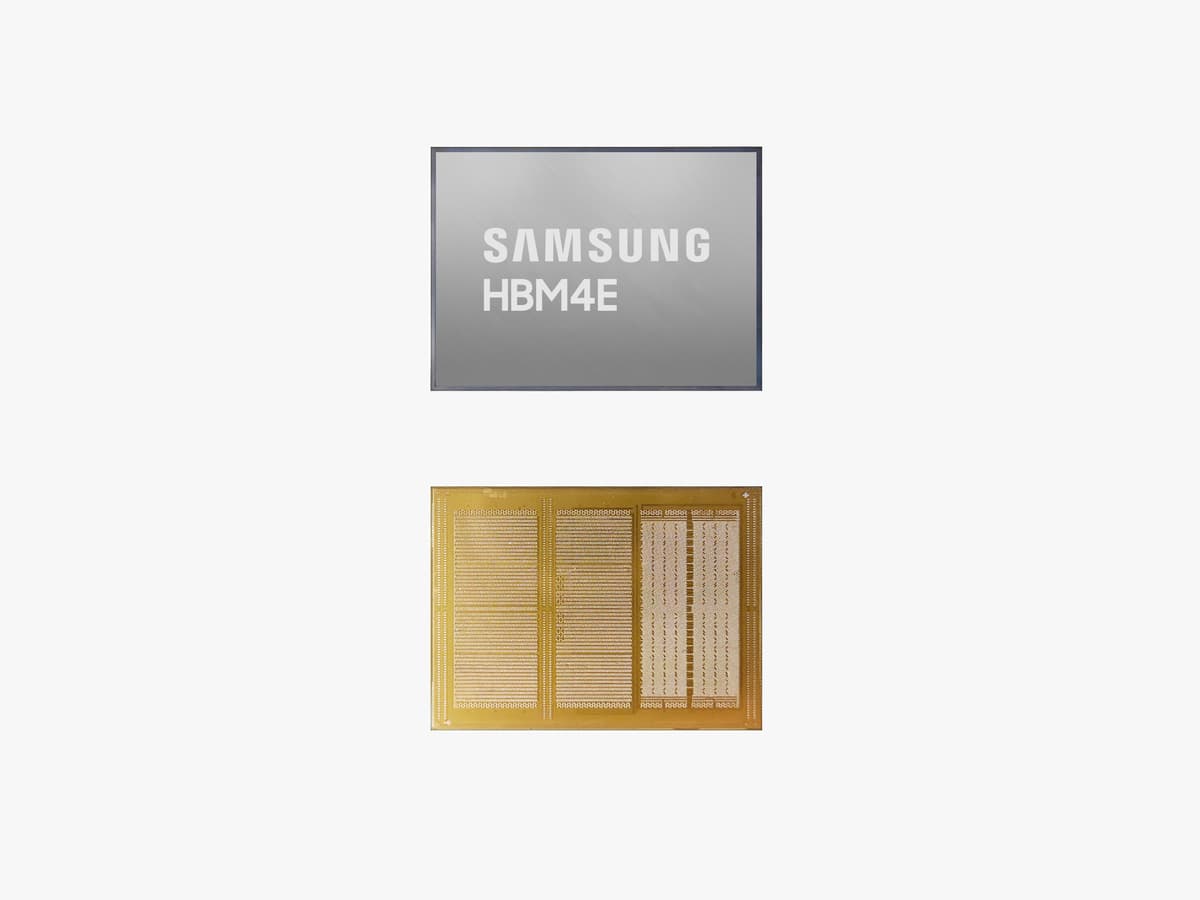
Here's the deal: on May 29, Samsung Electronics announced it had begun shipping the industry's first 12-high HBM4E samples. And the recipients weren't random — Nvidia, AMD, and Google, the three companies that effectively own AI accelerators and cloud infrastructure, all got qualification units at once.
The specs tell you why this matters. The parts run a stable 14 Gbps pin speed, scalable to 16 Gbps on demand — a 20%+ uplift over HBM4 — and deliver up to 3.6 TB/s of bandwidth per stack. The 12-high SKU packs 48 GB, more than 30% over the prior generation. But the real headline isn't speed, it's timing: Samsung pushed the next standard, HBM4E, into customer qualification just three months after starting HBM4 mass production. With SK hynix guiding its own HBM4E samples for 2H 2026 and mass production for 2027, Samsung just leapfrogged by several months.
If you remember the last few years as "HBM = SK hynix," this lands differently. SK hynix owned the HBM3E ramp for Nvidia's H200/B200 era while Samsung spent that cycle as the late challenger fighting through qualification. Now Samsung is first with HBM4E samples. We're watching a chaser take the front in real time.
The players — Samsung, and what HBM4E actually is
Samsung Electronics is the world's largest memory maker, but the HBM niche is its own beast. HBM stacks DRAM dies vertically, wires them with through-silicon vias, and sits right next to an AI accelerator to keep the GPU from starving for data. The hard part is the stacking — the more layers, the more heat concentrates, the more warpage, the worse the yield. So "how many layers can you stack reliably" is the scoreboard. Samsung's painful HBM3E memory was a late entry into Nvidia's mainline supply; this HBM4E lead is its attempt to flip that script.
HBM4E is the "extended" build of HBM4. Per Samsung, it pairs the industry's most advanced 6th-gen 10nm-class DRAM (1c) with a 4nm logic base die from Samsung Foundry. That logic base die is the inflection point: from HBM4 onward, the bottom die is built on a foundry/logic process rather than a memory process, letting controller-like compute sit directly under the stack. The memory/logic line is blurring — which favors a company that owns both memory and a foundry. Low-power design and optimized packaging push energy efficiency up 16% and thermal resistance up more than 14% versus the prior gen. In an AI datacenter, power and heat are money, so those two numbers matter as much as the bandwidth figure.
What shipped, how fast, and to whom
Here's the spec sheet — and remember, these are real qualification samples, not a marketing slide.
| Spec | HBM4E (12-high) | Note |
|---|---|---|
| Pin speed | 14 Gbps stable / up to 16 Gbps | 20%+ over HBM4 |
| Bandwidth/stack | up to 3.6 TB/s | targets next-gen GPUs |
| Capacity (12-high) | 48 GB | 30%+ over prior gen |
| DRAM process | 6th-gen 10nm-class (1c) | industry-leading |
| Base die | 4nm logic (Samsung Foundry) | memory + logic fusion |
| Energy efficiency | +16% | vs prior gen |
| Thermal resistance | +14%+ improvement | key datacenter metric |
| Shipped | 2026-05-29 | Nvidia, AMD, Google |
Samsung isn't stopping at 12-high. It's extending the lineup to 8-high (32 GB) and 16-high (64 GB), aiming squarely at the capacity arms race next-gen GPUs are about to demand. With Nvidia's next architecture almost certain to adopt HBM4/HBM4E, being first to hand over samples means standing at the front of an enormous queue.
Chew on the timing once more. Samsung started HBM4 mass production in early 2026, then shipped HBM4E 12-high samples just three months later. In semiconductors, a three-month gap between generations is a sprint with no breathing room — stabilizing a single node usually eats that much alone. It means Samsung developed HBM4 and HBM4E essentially in parallel, and it intends to be a pace-setter, not a chaser.
Who wins — Samsung, the GPU buyers, and even SK hynix
For Samsung, this is about narrative as much as revenue. Mass production will eventually mean enormous sales, but the bigger prize is shedding the "Samsung was late" label from the HBM3E era. Shipping first to Nvidia, AMD, and Google lifts Samsung's leverage in the next round of supply talks — pass qualification first and you get favored early-volume allocation, which is the highest-margin window.
For Nvidia, AMD, and Google, it's supply diversification. Leaning heavily on one vendor for next-gen HBM kept pricing power and supply security tense. A credible, early Samsung lets buyers play SK hynix, Samsung, and Micron against each other for better terms. Memory is both a bottleneck and a major cost line for AI-chip makers, so going from two real suppliers to three is a win by itself.
Even SK hynix gets something: a wake-up call. Last gen's leadership shouldn't curdle into complacency, and Samsung's May shipment pressures SK hynix to pull its 2H-sample, 2027-production timeline forward. The faster these two giants race, the sooner next-gen AI memory arrives, the more rational pricing gets, and the more the whole AI-infrastructure bottleneck loosens. The pride war between two memory titans is an accelerator for the entire industry.
History — does shipping first mean winning?
In HBM, "we sampled first" hasn't always equaled "we won." So weigh this carefully.
Win — SK hynix × HBM3E (2023–24). SK hynix qualified HBM3E with Nvidia first and effectively monopolized the H200/B200-era memory market. Being first to qualify bought early-volume exclusivity, fat margins, and the "Nvidia's HBM = SK hynix" brand. Lesson: in next-gen HBM, an early qualification pass converts into years of share. That's exactly the script Samsung is chasing now.
Cautionary — Samsung × HBM3E (2024). Conversely, Samsung "sampled but qualified late" with Nvidia on HBM3E, losing time on thermal and yield validation and opening a wide gap between samples and real volume. Lesson: a sample is just the starting line; the real contest is surviving Nvidia's brutal thermal/reliability qualification. Samsung leading with 16% efficiency and 14% thermal gains is a direct shot at that old weakness — a "this time it's different" proof attempt.
Near-miss — Micron's slow chase. Micron has the tech but trailed the Korea duo on capacity and entry timing, never capturing much share. Lesson: HBM rewards not just engineering but a capital bet on capacity laid down in advance. Samsung's ability to ship HBM4E three months after HBM4 implies that pre-investment — and that's where Micron diverges.
How rivals counter
SK hynix defends the HBM4 home turf while compressing its HBM4E schedule. Having already won next-gen HBM4 supply with Nvidia, it can grow that volume steadily and consider pulling HBM4E samples forward from 2H. Its edge is the trust and validation data built with Nvidia, so even if Samsung leads on specs, SK hynix counters with "proven stability." Spec war versus trust war.
Micron leans on Washington's domestic-chip push as a geopolitical card — US customers (especially government/defense-adjacent AI) wanting a domestic HBM supply chain may pay a policy premium, partly offsetting Micron's spec/capacity gap with "made-in-USA memory."
Nvidia and AMD enjoy the supplier fight while keeping the final call. Whoever samples first, the GPU maker holds the adoption knife — qualifying Samsung, SK hynix, and Micron in parallel to optimize price and supply, and even demanding custom base-die designs. With logic base dies arriving in HBM4, GPU-memory collaboration gets deeper, and so does dependence.
So what actually changes
For hardware-industry folks, the HBM4E supply map just reopened. The SK-hynix-dominant HBM3E order could become a real contest again in HBM4E, shaping two to three years of capacity investment, hiring, and equipment orders across all three memory makers. Samsung Foundry's 4nm logic base die landing inside HBM also signals that the memory-plus-foundry synergy is finally showing up in product — a big internal-strategy variable for Samsung.
For teams running AI infrastructure, it's bottleneck relief. 3.6 TB/s per stack and 48 GB (soon 64 GB) let bigger models run on fewer GPUs. Bandwidth and capacity are the ceiling on LLM training and inference, so the faster next-gen HBM ships in volume, the more room there is for per-token cost to fall. Set against this week's news of Microsoft killing internal Claude Code over runaway AI-coding bills, it's clearer than ever that one lever on the "AI cost crisis" is exactly this kind of hardware progress.
For investors and general readers, it's a reminder that the AI supercycle's real beneficiary is still memory. GPUs get the spotlight, but they starve without HBM evolving alongside. Samsung surging from chaser to front-runner shows how central Korean semiconductors are to the AI value chain. Just remember: samples don't equal Nvidia mass adoption — the true inflection is whether Samsung clears the next gate of qualification and yield.
References
- Samsung Newsroom — Begins Shipment of Industry-First HBM4E Samples
- Samsung Semiconductor Global — official product announcement
- TrendForce — Three Months After HBM4 Ramp, Performance Up Over 20%
- The Korea Herald — World's First 12-layer HBM4E Samples
- Seoul Economic Daily — Ships World's First HBM4E 12-High Samples