A reversal in three months — a scene that shows how short AI memory really is
Here's the deal: a corporate chairman publicly reversing his stance in just three months isn't common. But on June 2 in Taipei, exactly that happened. SK Group Chairman Chey Tae-won took the Computex 2026 stage and declared SK Hynix will double its total wafer production capacity within five years. This is the same man who, at Nvidia's GTC in March, said there was no plan for a new fab and that capacity couldn't be added on demand.
What turned him around? One answer — the AI memory shortage is far more severe and far longer-lasting than expected. Chey assessed that AI memory supply runs more than 20% below demand, and that the gap will likely persist until 2030. SK Hynix's entire 2026 HBM (high-bandwidth memory) allocation is already sold out. It's sold before it's even made.
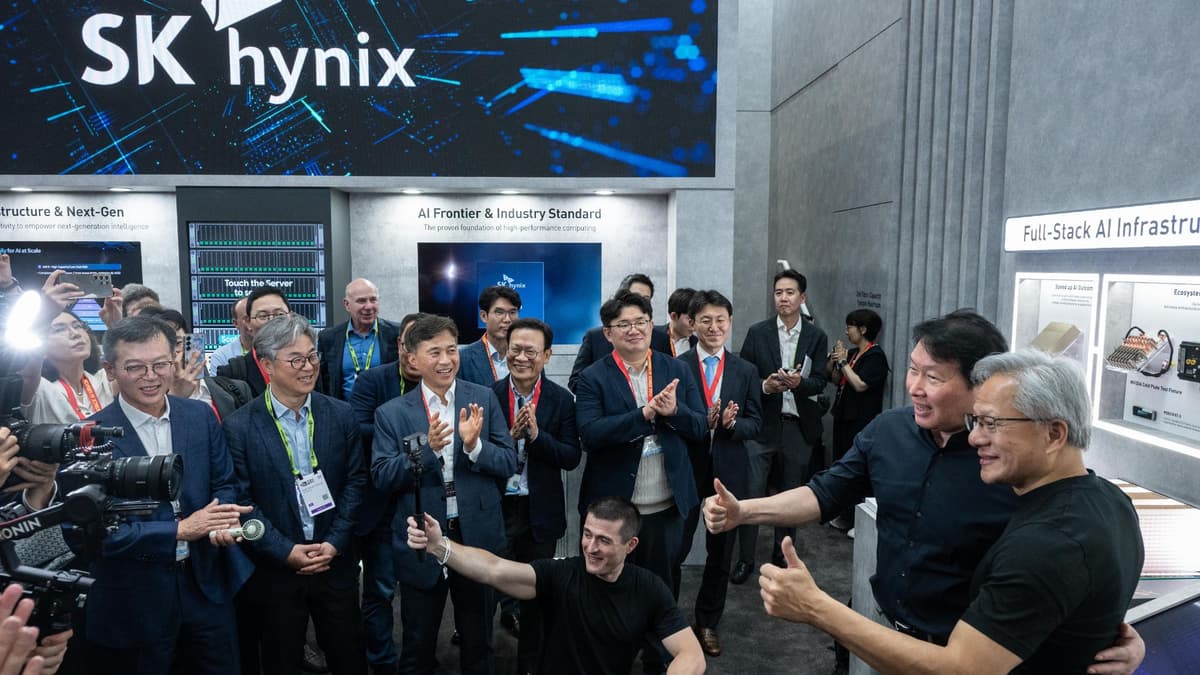
One image captured the mood of the announcement. At the show, Nvidia CEO Jensen Huang walked up to SK Hynix's booth and, with a marker, wrote "Please Make More" on a displayed HBM4E wafer. The head of the world's largest AI chip company hand-writing a plea to a memory maker — no picture better shows where power in the AI-era supply chain has moved.
The players — SK Hynix, Chey Tae-won, and Jensen Huang
First, SK Hynix. A Korean company that splits the world memory market with Samsung, it holds a commanding position as Nvidia's key HBM supplier for AI accelerators. Before the AI boom it was a "cyclical component company," but as AI made HBM the core bottleneck, it suddenly became something like "the heart of AI infrastructure." It's the protagonist of this capacity-doubling pledge.
Next, Chairman Chey Tae-won. Him personally taking the Computex stage to promise "2x in five years" carries weight. More interesting is his "March-to-June" shift — a man who was cautious in March turned to "full-speed expansion" by June. That reversal mirrors how fierce demand and customer pressure became in between. He also said SK Hynix aims to be the main supplier for Nvidia's next-gen platform (Vera Rubin).
The last player is Jensen Huang. As Nvidia's CEO he looks like the one holding all the cards in AI chips, but in this scene he acted like the supplicant — going to a memory maker's booth to write "Please Make More." It's not just theater. No matter how many GPUs Nvidia builds, without the HBM to pair with them it can't make AI accelerators. In effect, Huang personally acknowledged that the real bottleneck for AI accelerators is memory, not the GPU.
What's inside — the numbers and the reversal
The core points:
| Metric | Detail |
|---|---|
| Announcement | Double wafer capacity within 5 years |
| When/where | June 2, 2026, Computex 2026 (Taipei) |
| Supply gap | More than 20% below demand |
| Shortage duration | Forecast to ~2030 |
| 2026 HBM | Fully sold out |
| DRAM capacity target | ~550K → ~1M wafers/month (~2030) |
| March stance | "No new fab, can't add capacity on demand" (pre-reversal) |
The most important thing is the strategic reversal itself. The memory industry carries trauma from past "chicken games" — everyone expanded capacity, then oversupply crashed prices. That's why Chey was cautious in March. Pledging "2x" in June means he hardened the judgment that AI demand is structural, not a passing bubble. This isn't just SK Hynix's call — it symbolizes a shift in how the whole industry sees the AI memory supercycle.
The second is the "sold out" fact. 2026 HBM already being fully sold means customers take it as fast as it's made. Some customers have reportedly offered to buy the EUV lithography scanners SK Hynix would use, or to prefund new production lines. That's a "supplier sets price and terms" market — a completely different power structure from the era when memory was cheap and plentiful.
The third is the real weight of expansion. Doubling capacity isn't just building more fabs. It requires securing EUV tools, sites, power, and people, plus astronomical capital expenditure. SK Hynix's 2025 capex was around 30 trillion won, and a "2x in five years" goal signals investment well beyond that. It's also a double-edged sword — "hit first if oversupply comes" — which is exactly why the industry had been cautious about expanding.
Who wins — SK Hynix, Nvidia, and Korea's economy
For SK Hynix, it cements market dominance. If AI memory demand is structural, expanding capacity preemptively now captures the market for years. In a "sold out" situation, expansion translates directly into revenue growth, and cementing main-supplier status for Nvidia's next-gen platform strengthens long-term contracts and pricing power. But it's also a decision that shoulders enormous capital risk.
For Nvidia, clearing the bottleneck is urgent. However it designs GPUs, an HBM shortage blocks accelerator shipments. Huang's "Please Make More" looks like a joke, but it's really an expression of urgency that Nvidia's growth is tied to memory supply. If SK Hynix doubles capacity, Nvidia can ship that many more accelerators — the two are in the same boat.
For Korea's economy, it's a huge boon and a burden at once. Memory is a core pillar of Korean exports, and the AI supercycle is delivering record results to SK Hynix and Samsung. At the same time, large-scale expansion like "2x in five years" brings massive investment and power/labor demands, spilling into questions of national resource allocation. The key is that AI memory has become a variable that can shape Korea's economic fate.
Past parallels — lessons from the memory cycle
The memory industry is notorious for its "boom and bust" cycles. History gives a balanced lesson.
Memory of boom — the sweetness of supercycles. In 2017–18, overlapping data-center and mobile demand spiked memory prices in a "supercycle," and SK Hynix and Samsung posted record profits. The industry view is that the HBM shortage AI created now is more structural than then — the amount of memory in a single AI accelerator is exploding. The "2x pledge" expresses a will to ride this boom to the end.
Warning of bust — scars of the chicken game. At the same time, memory has repeated cycles where "everyone expands, oversupply crashes prices." Such downcycles hit in late-2018–2019 and 2022–23, bruising firms that over-expanded. Chey's caution in March stemmed from that trauma. SK Hynix's bet is that "2x expansion" is a decision grounded in structural demand, not a peak-of-boom misstep.
A transition variable — HBM4E and beyond. HBM grows more complex and expensive each generation (HBM3E → HBM4 → HBM4E). Even doubling capacity, you must also succeed at next-gen process transitions to stay competitive. It's a dual task — making not just "more" but "faster, more efficient" memory in volume. The tech gap with Samsung and Micron decides the contest here.
Competitor counter-plays — Samsung, Micron, and customer in-housing
First, Samsung Electronics. Seen as a step behind SK Hynix in HBM, Samsung views this shortage as a chance to catch up. It's aggressively expanding HBM mass production and capacity, aiming to overtake SK Hynix in next-gen HBM. SK's "2x pledge" pressures Samsung to "expand more too" — ultimately staging an expansion race between the two Korean firms.
Micron (US) is formidable too. As the third HBM player, it's expanding capacity, backed by US government chip support and an "AI memory reshoring" push. Customers like Nvidia don't want supply concentrated in one place, so they deliberately allocate some volume to Micron for diversification — a potential variable that could crack SK Hynix's dominance.
Customer in-housing and custom memory offer a bypass. Big techs like Google, Amazon, and Meta design their own AI chips and want to optimize memory configurations directly. Long term, demand could shift beyond "commodity HBM" to "custom memory" — both an opportunity and a threat for suppliers. If SK Hynix embraces customer-specific designs, lock-in strengthens; if not, it could cede ground to big-tech in-housing.
So what actually changes — by persona
If you watch semiconductors or markets, this signals that "the AI memory supercycle being structural" has hardened into consensus. SK Hynix pledging the large-scale expansion the industry had so carefully avoided means it sees long-term demand, not a short boom. Watching HBM/DRAM prices, capex cycles, and Korean export figures together has become important.
If you handle AI infrastructure, the key is that the bottleneck moved from GPU to memory. Securing AI accelerators now means weighing HBM supply, not just GPU volume. If the shortage runs to 2030, memory's share and volatility within AI infrastructure costs will grow. It's an era to plan procurement on a long horizon.
If you watch AI broadly, the message is that AI is ultimately a game of physical resources. However smart the model, it stalls without enough chips, memory, and power to run it. Huang hand-writing "Please Make More" on a wafer symbolizes that AI — perched atop software's illusions — is actually bound to a hard physical world of fabs, wafers, and grids. That's why you should watch "memory, power, fabs" as much as "models."
Numbers and figures are as of announcement and may change. Investment calls are yours to make!
🥄 Three Things You're Probably Wondering
— Why did Chairman Chey reverse course in three months? Because AI memory demand and customer pressure proved far stronger than expected in between. In March he was cautious due to "chicken-game trauma"; by June the judgment hardened that "AI demand is structural and the shortage runs to 2030." The fact that 2026 HBM is fully sold out is itself the basis for that judgment.
— Did "Please Make More" really happen? Yes — multiple outlets reported Jensen Huang wrote it directly on an HBM4E wafer at SK Hynix's Computex booth. It looks like theater, but the message is serious: it expresses urgency that Nvidia's AI-accelerator shipments are tied to memory supply. It's a scene showing where supply-chain power sits in the AI era.
— Doesn't doubling memory crash prices and hurt them? That's the classic memory dilemma — everyone expands, oversupply crashes prices. SK Hynix's bet is that "AI demand is so structural that even 2x gets absorbed." If that judgment is right, it captures the market; if wrong, it takes the downcycle hit first. "2x" is that big a bet.
— Does this affect a regular consumer like me? Indirectly, yes. If capacity tilts toward AI HBM, supply of ordinary DRAM and NAND for PCs and phones tightens and prices can rise. In fact, prioritizing AI memory production is already making consumer memory prices wobble. The AI infrastructure race ultimately reaches even your laptop's price.
References
- SK Hynix to Double Wafer Capacity to Ease Memory Chip Crunch — Bloomberg
- SK hynix to double memory wafer capacity within five years, chairman says — Tom's Hardware
- Chipmaker SK Hynix to double wafer capacity in 5 years to meet AI demand — Nikkei Asia
- SK Group Chairman Chey Says SK hynix to Double Wafer Capacity Within Five Years — The Elec
- SK hynix — Newsroom