Tens of billions of dollars decided by three weeks — the HBM4E sample war is back on
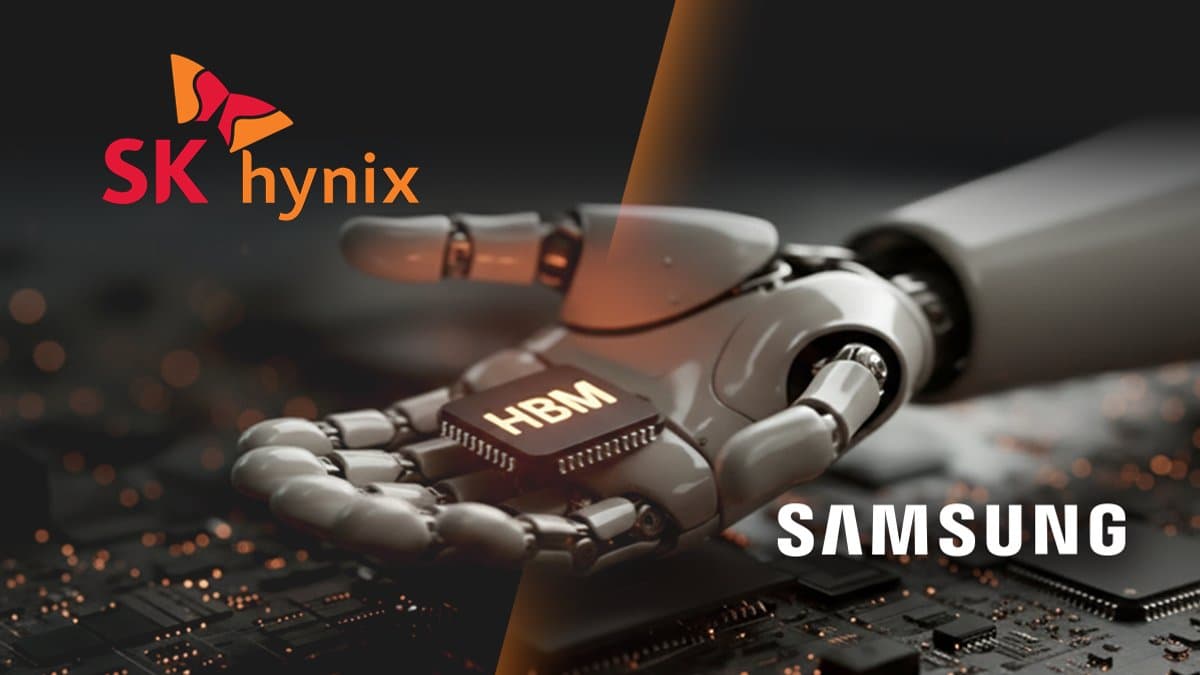
The two memory giants just collided head-on again. Samsung Electronics fired the starting gun on May 29 when it announced it had shipped "industry-first" next-gen HBM4E 12-layer samples to global customers. Then SK Hynix answered exactly three weeks later, on June 18, by shipping its own HBM4E samples. Three weeks. In the semiconductor cycle, three weeks can feel short or long depending on your angle — but this time those three weeks became the starting line for who wins tens of billions of dollars in next year's AI accelerator volume.
Here's the funny part: the specs are almost carbon copies. Both are 12-layer, 48GB, up to 16Gbps. Stare at the numbers and you'll ask, "So what's actually different?" That's precisely why the market's attention has already shifted away from raw performance and toward a different question: who gets a whale like Nvidia through qualification first? Shipping samples earlier means starting customer validation earlier, and that becomes a strategic edge when the mass-production contracts get signed.
And this story happens to land on the very same day (July 10) that SK Hynix debuts on the Nasdaq. SK Hynix is raising roughly $29 billion through American depositary receipts in what could be the biggest-ever first-time share sale by a foreign company. Its stock has soared over 280% this year, pushing its market cap past $1 trillion. In an era where the AI-memory boom basically is the company's valuation, this three-week HBM4E race isn't just tech news — it's a fight over both companies' future cash flows. I'll keep the listing as background and dig into the product race itself.
The cast — Samsung, SK Hynix, HBM4E, and Nvidia as the referee
Start with SK Hynix. This is the reigning champion. In the HBM3E generation, it became the effectively exclusive supplier to Nvidia's H100 and H200, pushing its HBM market share into the low 60% range. This is the company that turned "AI memory = SK Hynix" into a formula, and it has the thickest trust relationship with Nvidia. For HBM4E, it actually pulled forward the sample timeline — on its April earnings call it had said "second half," then it shipped in June instead. That's a champion rushing to defend the belt.
Next, Samsung Electronics — the challenger carrying a painful memory. In the HBM3 generation, Samsung repeatedly failed to clear Nvidia's qualification, held back by heat and yield issues, and only finished HBM3E validation in 2025. That earned it a humiliating framing: "the world's No. 1 memory maker, yet a perpetual runner-up in the hottest market of all." This time is different, though. In HBM4E, Samsung grabbed the industry-first sample title three weeks ahead of SK Hynix. For Samsung, this is the redemption bet.
So what is HBM4E? It's the latest generation of High Bandwidth Memory, the ultra-fast memory bolted onto AI accelerators. In the lineage of HBM3 → HBM3E → HBM4 → HBM4E, it's the most advanced product going right now. It sits right next to the GPU on a silicon interposer and shovels enormous amounts of data in real time. In large language model training and inference, the bottleneck is usually not compute but memory bandwidth — so HBM performance basically becomes AI-system performance.
And the referee judging all of this is Nvidia. At Computex 2026 in early June, there's a now-famous moment where Jensen Huang stopped by SK Hynix's booth and wrote "Please make more" on an HBM4E wafer — a live demonstration of demand for next year's Rubin Ultra platform. When SK Group Chairman Chey Tae-won mentioned the company currently has "a single HBM4E customer," he was effectively pointing at Nvidia. In the end, this three-week race gets settled by whose product gets Nvidia's stamp first.
Finally, you have to add the next front, HBF (High Bandwidth Flash), to the cast. It's a new memory tier that SK Hynix and SanDisk began standardizing back in February, sitting between HBM and SSD as an "inference-only" storage layer. It's not as fast as HBM, but it packs 8–16 times the capacity and runs more than 50 times faster than a PCIe 5.0 SSD. Samsung has jumped in too, and both companies are aiming for commercialization in 2027 with samples in the second half of this year. If HBM4E is the speed fight of training and inference, HBF is the capacity fight of the inference-explosion era.
What HBM4E actually is, and why these three weeks matter
Let's crack HBM4E open a bit more. HBM stacks multiple DRAM chips vertically and connects them with TSVs (through-silicon vias). "12-layer" means twelve DRAM dies stacked, with a logic base die at the very bottom acting as the brain. Starting with HBM4, that base die evolved from a simple pass-through into a smart chip that handles part of the computation — which dragged foundry-process competitiveness into the HBM fight for the first time.
Samsung's approach targets exactly that seam. For this HBM4E, Samsung paired its own 6th-generation 10nm-class (1c) DRAM with a Samsung Foundry 4nm logic base die. That's the vertical-integration card — DRAM, logic, and packaging all under one roof. Its specs: a stable pin speed of 14Gbps scalable up to 16Gbps, up to 3.6TB/s of bandwidth per stack, and 48GB in 12 layers. It plans to widen the lineup to 32GB (8-layer) and 64GB (16-layer).
SK Hynix answered the performance numbers head-on: 16Gbps per pin, 48GB in 12 layers, power efficiency improved over 20% versus the previous generation, and heat resistance up 17% versus HBM4. On top of that, it leaned on its signature Advanced MR-MUF (a packaging technique that fills the gaps between dies with molding compound in a single pass), stressing that it stacked 12 layers while keeping structural stability. The champion is playing the trust card: "We've actually mass-produced multiple HBM generations — we have the track record."
So why do these three weeks matter so much? The crux is qualification. A customer that receives samples plugs them into its own systems and validates performance, heat, and yield over several months. Only after passing that validation do mass-production orders flow — so shipping samples three weeks earlier means you can spin the validation-and-optimization cycle that much sooner. In chips, once you clear qualification, you effectively lock up that generation's volume, so a head start of days or weeks gets amplified into later market share. One crucial caveat, though — per an industry official, both companies have only shipped samples; neither has announced clearing qualification or starting volume production. The real contest starts now.
| Item | Samsung HBM4E | SK Hynix HBM4E |
|---|---|---|
| Sample announcement | May 29, 2026 (claims industry-first) | June 18, 2026 (~3 weeks later) |
| Stack / capacity | 12-layer / 48GB | 12-layer / 48GB |
| Pin speed | Stable 14Gbps, up to 16Gbps | 16Gbps per pin |
| Bandwidth | Up to 3.6TB/s per stack | 16Gbps-class (no official TB/s figure) |
| Process / signature | 6th-gen 1c DRAM + Foundry 4nm base die | Advanced MR-MUF packaging |
| Power & heat | 16% better efficiency, 14% better thermal vs HBM4 | 20%+ power efficiency, 17% heat resistance vs prior |
| Lineup roadmap | 32GB (8-layer), 64GB (16-layer) planned | 12-layer focus, timely mass production TBD |
| Key customer | Global AI / hyperscale customers | Nvidia et al. (Chey: "one customer") |
| Qualification status | Sample stage (not cleared) | Sample stage (not cleared) |
What each side gains — champion defends, challenger counters, referee dual-sources
What SK Hynix is trying to protect is clear: its 60%-plus HBM share and its status as "Nvidia's No. 1 partner." That premium, built up over HBM3E, is the basis for this year's 280% stock surge, the $1 trillion market cap, and today's Nasdaq debut. Following up within just three weeks in HBM4E is a declaration: "We're not handing over the crown." When you see it reinvesting the ~$29 billion it raised into fabs and equipment, plus building its first U.S. packaging plant in Indiana (completion in 2028), you can see it's ready to go the distance in this volume war.
What Samsung wants is a comeback narrative. It's trying to reclaim, via the HBM4E "industry-first sample," the leadership it lost in HBM3 and HBM3E. The DRAM-plus-foundry vertical integration is a weapon SK Hynix can't easily copy, so Samsung is pushing "we build the logic base die ourselves" as its differentiator. Clear even one Nvidia qualification cleanly here, and Samsung's whole semiconductor earnings and stock narrative flips. That's how much is riding on this.
What Nvidia gains is leverage. With two suppliers (effectively three), it can pull price, volume, and timing in its favor. Having felt the pain of over-relying on SK Hynix during the HBM3E days, Nvidia is delighted to see Samsung showing up with a competitive HBM4E. Jensen Huang's "Please make more" is both affection and pressure — a signal that says, "Both of you, compete hard and give me plenty of volume."
And the whole AI infrastructure buildout benefits. When HBM supply is tight, data-center expansion gets bottlenecked by memory — so when two companies trade blows three weeks apart, the odds go up that next-gen memory arrives sooner and in greater quantity. For a next-year platform like Rubin Ultra to roll out on schedule, HBM4E has to hit mass production on time, and this rivalry effectively moves that clock forward.
Déjà vu — the HBM3E qualification war and Samsung's painful memory
This picture isn't actually new. The exact same drama played out in the immediately prior generation, HBM3E. Back then SK Hynix cleared Nvidia's qualification first and effectively monopolized H100 and H200 volume, while Samsung kept slipping on heat and yield problems, only finishing validation in 2025. That's when the humiliating frame hardened for Samsung: "the world's No. 1 memory maker is a perpetual No. 2 in the hottest AI-memory market."
Look at memory-cycle history and these "qualification battles" keep flipping the board. When DRAM prices are strong, whoever gets qualified first and grabs the volume hogs the margin, while the late one dumps leftover supply at low prices and gets hurt worse when the cycle turns. HBM adds customer customization on top, so once a part is optimized for a particular GPU, that relationship carries into the next generation — the lock-in is strong. That's exactly why sample-and-qualification timing at the start of a generation matters so much.
That's why Samsung fixated so hard on the "industry-first sample" this time. With the trauma of losing volume by three weeks — no, by months — in HBM3E, it wanted to be ahead right at the starting line for HBM4E. Conversely, SK Hynix pulling its schedule forward from the "second half" it cited in April to June follows the same logic — the champion couldn't stomach even a three-week head start for the challenger. This three-week race is a product of HBM3E's scars and lessons.
That said, history also says "shipping first doesn't always mean winning." The first-sample title, actually passing qualification, and stable high-volume production are entirely different problems. Remember that Samsung's HBM3 demos were flashy but collapsed on production yield — so a "3.6TB/s first" headline doesn't automatically mean victory here either. The real test bench is the customer-validation results this summer and fall.
The counter-play — Micron, Nvidia's dual-sourcing, and custom HBM
You can't leave out the third player: Micron. It's the perennial No. 3 in HBM, but its presence is growing. Micron already put HBM4 36GB 12-high into mass production in the first quarter of this year for Nvidia's Vera Rubin, and it has even shipped 48GB 16-high samples to customers. Its share has climbed into the low 20% range, with some analyses saying it briefly passed Samsung. So HBM4E isn't just a Samsung-vs-SK affair — Micron, the only U.S. HBM supplier, is charging up the middle, riding demand from Nvidia and the U.S. government for supply-chain diversification.
Nvidia's dual-sourcing strategy is the hidden rule of this game. The GPU king never pins its fate on a single memory company. After learning that SK Hynix dependence was a risk in HBM3E, it lines up three suppliers for HBM4 and HBM4E and makes them compete. That way, if one company stumbles on yield, the line doesn't stop — and Nvidia keeps the pricing leverage. The tension created by Samsung's "industry-first" and SK Hynix's "three-week chase" is, in fact, exactly the picture Nvidia wanted.
Another big current is custom HBM. As the base die got smart starting with HBM4, we're entering an era of "tailored HBM" where customers embed the compute functions they want into that logic die. It's not just Nvidia — hyperscalers building their own AI chips (ASICs), like Google, Amazon, and Microsoft, have started demanding HBM tuned to their tastes. Here, Samsung, which owns its own foundry, could have an edge, while SK Hynix responds through its TSMC collaboration. Once custom competition kicks into gear, the deciding factor shifts from "who has the higher spec number" to "who best absorbs customer requirements."
And the aforementioned HBF extends this front sideways. As inference demand explodes, a gap opened up — "HBM is too expensive and short on capacity, but SSD is too slow" — and HBF is trying to fill it. With Samsung joining the SK Hynix–SanDisk camp, the two companies will square off again not just in HBM4E but in HBF standards and samples. In other words, this three-week race isn't a one-off event — it's one scene in a long war for "inference-chip supremacy" running from HBM4E to custom HBM to HBF.
To sum up, the board has gotten far more complex. Where it used to be a two-way duel between SK Hynix and Samsung, it's now a multi-dimensional game with Micron as a third axis, Nvidia dual-sourcing, and custom HBM plus HBF as new fronts. That's why Samsung can't rest on being first-to-sample, and SK Hynix can't rest on being champion.
So what actually changes — by persona
For the AI-hardware watcher, the HBM4E three-week race is an early signal of the performance ceiling for next year's AI accelerators. Samsung's 3.6TB/s and SK Hynix's 16Gbps-class specs will become the memory bandwidth of next-gen platforms like Rubin Ultra. The numbers are fluid at the sample stage, but the mere fact that two companies are competing this tightly is a trailer for "next year's AI chips will have their memory bottleneck loosened dramatically." Just don't declare which company actually wins the volume until a qualification-pass announcement lands.
For the investor, remember that the valuation of SK Hynix — debuting on the Nasdaq today — basically hinges on this HBM race. The 280% stock surge and $1 trillion market cap rest on the premise that it keeps the HBM crown. If Samsung clears HBM4E qualification first, or Micron steals volume, that premise wobbles. Defend successfully, and the premium is justified. Samsung is the opposite — an underdog-rebound story, so a HBM4E success opens up more upside room. (This is a framework for reading the board, not investment advice.)
For the data-center and cloud buyer, supply diversification is good news. A three-way fight among Samsung, SK Hynix, and Micron stabilizes HBM prices and expands volume, easing the GPU-server procurement bottleneck that much. The real constraint on AI-infrastructure expansion these past few years wasn't the GPU — it was the HBM stacked on top of it. If this rivalry lifts that supply, you can plan data-center expansion more aggressively. But thanks to the custom-HBM trend, the era of "any HBM will do" is over — so if you're a hyperscaler running your own chips, early collaboration with your supplier matters more and more.
In one sentence — these three weeks don't tell you who won right now, but they're the flare signaling that next year's AI-memory board has reopened. The real result shows up on the qualification report card this summer and fall.
🥄 Three Things You're Probably Wondering
— If Samsung shipped samples "industry-first," did Samsung win this round? Nobody's won yet. The first-sample title, actually clearing customer qualification, and stable mass production are completely different things. Samsung has a history of flashy demos in HBM3 that then collapsed on production yield, so the real contest won't be clear until the summer-and-fall validation results are in.
— If the specs are nearly identical, what actually decides the winner? In the end, it's Nvidia's stamp. With 12-layer, 48GB, 16Gbps numbers that are near-carbon-copies, the fight has moved off performance and onto "who gets Nvidia and the whales through qualification first and lands the volume contract." Jensen Huang writing "Please make more" on an SK Hynix wafer wasn't a random viral moment.
— What even is HBF? Is it different from HBM? It's a new storage tier that sits between HBM and SSD. It's not as fast as HBM, but it packs 8–16 times the capacity and runs 50-plus times faster than an SSD, making it a perfect fit for the inference-explosion era. Both Samsung and SK Hynix are aiming for commercialization in 2027, so the front after HBM4E opens right here.
Sources
- SK hynix Ships Samples of 12-Layer Next-Gen 'HBM4E' (SK hynix Newsroom)
- Samsung Electronics Begins Shipment of Industry-First HBM4E Samples (Samsung Semiconductor Newsroom)
- SK hynix ships HBM4E samples, joining Samsung in next-gen memory race (Korea Herald)
- SK hynix Ships 12-High HBM4E Samples, Boosts Bandwidth to 16Gbps (TrendForce)
- Meet SK Hynix, the trillion-dollar chipmaker debuting on U.S. markets (CNBC)
- Micron in High-Volume Production of HBM4 Designed for NVIDIA Vera Rubin (Micron IR)
Numbers are as of announcement and may change.