The Samples Are Done — Now the Real Thing Is Rolling to Nvidia
Here's the deal: for months, headlines kept saying SK Hynix was "sending HBM4" to Nvidia. But what actually crossed the fence was mostly samples — the "here's how fast this runs, go validate it" kind of product. The reporting that landed on July 13–14 is a different animal. This time it's the final-specification, production-grade 12-layer HBM4 that has cleared every one of Nvidia's quality certifications — the real stuff that gets soldered onto a GPU and ships to data centers. The target: Nvidia's next-generation AI platform, "Vera Rubin."
The timing was almost cinematic. Just days earlier, on July 9–10, SK Hynix listed American Depositary Receipts (ADRs) in New York and raised a staggering $26.5 billion. That was the largest-ever first-time US listing by a foreign company, edging past Alibaba's $25 billion debut back in 2014. Before the glow of that listing had even faded, the "HBM4 mass-production shipments begin" news stacked on top — and SK Hynix's ADR surged 17% in a single session on July 14 to $178.66, an all-time high since listing, erasing the small dip it had suffered right after its debut.
Put it together and the picture is clean. The company raised a record pile of cash in the US market, and the product it will build in the factories that money funds (HBM4) is already rolling out to the world's biggest AI company (Nvidia). The front and back of the growth story lined up perfectly, and the market went wild. In this piece, I'll unpack why this single move matters so much, and exactly what SK Hynix, Nvidia, and Samsung each stand to gain — and what each has on the line.
The Players — SK Hynix, Nvidia, and the Shadow Named Samsung
Calling SK Hynix "a memory maker" now undersells it. In the memory of the AI era — specifically HBM (high-bandwidth memory) — it's effectively the kingpin. It all but monopolized the HBM3E that went into Nvidia's H100, H200, and Blackwell chips, which sent earnings through the roof, and it's now trying to extend that streak into HBM4. In September 2025, it announced it had completed the world's first HBM4 development and readied a mass-production system. This shipment is the moment that declaration turns into actual revenue.
Nvidia is the undisputed heavyweight of AI accelerators. It holds most of the data-center GPU market, and it's barely an exaggeration to say the entire AI boom hangs on this one company's chip supply. The star of this story, "Vera Rubin," is the next-generation platform succeeding Blackwell. Each GPU packs eight HBM4 stacks, and it's slated for full production in Q3 2026. The generation after that, "Vera Rubin Ultra," will use twelve HBM4E stacks per GPU — but that's a 2027 story.
Here's a crucial point: Nvidia doesn't buy HBM from just anyone. Memory bound for its GPUs has to pass brutal speed, thermal, and yield thresholds to earn a "qual" (qualification), and that gate is notoriously hard to clear. So when SK Hynix ships "final specifications that have completed all quality certifications," it means it cleared that punishing gate. It crossed the wall between sample and production — a wall that looks thin but is actually very thick.
Samsung Electronics is the supporting character and the rival in this story. Once the memory king, it repeatedly failed Nvidia's HBM3E qual and handed leadership to SK Hynix. But in 2026 it's fighting back. On February 23 it claimed to be the first in the world to begin HBM4 mass-production shipments, and reports say it started supplying Nvidia from June. On top of that, having watched SK Hynix's successful US listing, Samsung is reportedly exploring its own ADR issuance. For SK Hynix, the back of its neck keeps prickling.
The Core Story — Just How Impressive Is This Thing?
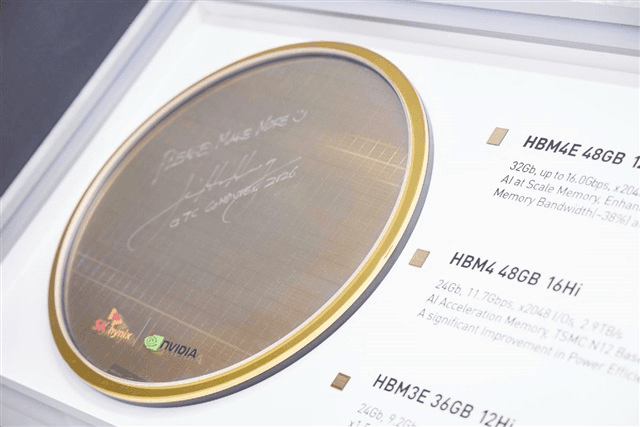
The spec sheet explains why this HBM4 matters. HBM4 doubles the I/O terminals from 1,024 to 2,048 versus the prior generation (HBM3E). In plain terms, it widens the data highway to twice as many lanes. That pushes bandwidth way up — a 12-layer stack processes more than 2 terabytes (TB) of data per second. Capacity hits 36GB per 12-layer stack, the highest in its class, and power efficiency improves by more than 40% over the previous generation. In AI training and inference, the bottleneck isn't just raw compute — it's how fast memory can feed the data in. HBM4 is the key that breaks exactly that bottleneck.
Let's nail down the shipment cadence too. Actual production-grade shipments began at the end of June, and the company is now in the early "ramp-up" phase of scaling capacity. From September, it plans to sharply expand shipment volumes to properly cover Nvidia's demand. In other words, the door is open now, but the big revenue surge comes in the second half. The allocation picture is clear as well. UBS and others peg SK Hynix at roughly 70% (estimates range 60–70%) of Nvidia's HBM4 volume, Samsung at 25–30%, and Micron taking the rest. SK Hynix is still the runaway leader.
| Item | Detail |
|---|---|
| Product | 12-high HBM4, final production spec |
| Customer/Platform | Nvidia "Vera Rubin" (8 HBM4 stacks per GPU) |
| Shipments began | Late June–July 2026 (production, not samples) |
| Full ramp | Volume ramp-up from September 2026 |
| Key specs | 2,048 I/O (2x), 2TB/s+ bandwidth, 36GB per 12-layer, 40%+ power efficiency gain |
| Market share (HBM4, est.) | SK Hynix 60–70%, Samsung 25–30%, Micron remainder |
| Capital-markets event | July 9–10 Nasdaq ADR raised $26.5B (largest-ever foreign US listing) |
| Stock reaction | July 14 ADR +17%, $178.66 all-time high |
Let me be honest about one uncertainty. The 60–70% share is an analyst/industry estimate, not a figure the company has officially confirmed. And the original DIGITIMES article sits behind a paywall, so while I confirmed the skeleton ("shipments started late June, expansion in September"), the granular volume figures need re-verification. The $26.5B ADR, the 17% surge, and the HBM4 specs, however, are cross-checked facts via Bloomberg, Al Jazeera, CNBC, and SK Hynix's own newsroom.
What Each Player Gains
What SK Hynix grabs most is the "first-mover premium." Once HBM passes qual and enters production, customers can't easily switch suppliers. Why take on risk swapping out a part whose performance, yield, and thermals are all validated? So being first to lock final-spec HBM4 into Nvidia's Vera Rubin means SK Hynix captures a big slice of that platform's revenue across its entire life cycle. And having just raised $26.5 billion, it can pour that cash into more Korean fabs and EUV lithography scanners to crank out more volume. The virtuous loop — cash to factories to product to revenue — is complete.
Nvidia's gain is supply stability. An AI accelerator isn't finished with a great GPU die alone; the HBM sitting beside it has to be supplied in sufficient volume, reliably, to yield a finished product. With validated SK Hynix delivering HBM4 in bulk, Nvidia can hold its Vera Rubin production schedule — which translates directly into its ability to sell GPUs to clouds and Big Tech on time. At the same time, by lining up Samsung and Micron as additional suppliers, Nvidia keeps the negotiating leverage that comes from not being married to a single vendor.
Samsung isn't frozen out of this game either. It got a 25–30% allocation and secured a talking point ("world's first mass-production shipment") back in February. Above all, Nvidia benefits from having multiple suppliers, so it has an incentive to keep nurturing Samsung. For Samsung, this cycle is a chance to reclaim the pride it lost during the HBM3E era.
From an investor's lens, here's the one-line summary of who got how much: SK Hynix simultaneously nailed "technology lead + capital raise," Nvidia secured "supply diversification + schedule defense," and Samsung earned "a foothold for a comeback." All three win — but the thickness of those wins differs, and that's the point.
Historical Parallels — The Wins and the Failures
The closest success story is the immediately prior generation, HBM3E. Across 2023–2024, SK Hynix effectively monopolized the HBM3E going into Nvidia's H100 and H200, and earnings exploded. Memory is normally a "commodity whose price swings," a business with lumpy margins — but HBM, where a single mega-customer named Nvidia pays a premium to buy it, became a completely different game. This HBM4 land-grab is an attempt to extend that HBM3E success formula one generation further.
The painful failure, by contrast, is Samsung's HBM3E qual delay. Throughout 2024, Samsung repeatedly failed Nvidia's HBM3E quality certification. Heat and power problems tripped it up, and while it stumbled, SK Hynix ate the whole market. The company once called the "memory king" showing up late to the most lucrative AI-memory party was the painful arc of the past two years. Samsung's rush in February to claim "world's first HBM4 mass-production shipment" can be read as a reaction to that trauma.
Zoom out further and the memory industry itself has a history of repeating "supercycle and crash." The 2017–2018 data-center boom sent DRAM prices soaring, then inventories piled up and prices collapsed in 2019; in 2022–2023, softening phone and PC demand pushed memory makers into massive losses. So even amid today's HBM boom, the "this time it's different" vs. "it's just another cycle" debate rages on. If AI demand is truly structural, HBM4 becomes an extension of a long boom; if there was froth in AI capex, orders could snap at some point. Keep both sides of that in mind.
How Rivals Counter — What Do Samsung and Micron Do Next?
Samsung's counterattack rests on three cards. First, use HBM4 built on its latest DRAM node (1c) to lift performance and yield and push its Nvidia allocation above 25–30%. Second, win customers beyond Nvidia — like AMD — to build a portfolio that contrasts with SK Hynix's Nvidia-concentration risk; there's talk Samsung is chasing both Nvidia and AMD on HBM4. Third, mirror SK Hynix by weighing a US ADR issuance and fighting back in the capital markets too. The catch: having lost trust once with HBM3E, Samsung has to prove itself with "passed quals," not words.
Micron leans on being a US company. Amid the US drift toward favoring domestic chip production, it can chase a geopolitical premium on volumes tied to US data-center customers or government-adjacent buyers. Micron made the HBM4 supplier list too and is expanding capacity in Idaho, Japan, and elsewhere. Still, it trails SK Hynix on absolute volume and technology maturity, so for now it's the number-three runner filling in the "remainder."
Longer term, latecomers like China's CXMT are a wildcard. They're several generations behind at the HBM frontier, but backed by domestic demand and government support they could erode the commodity HBM market from the bottom up. Of course, US export controls on China are blocking cutting-edge HBM from flowing in, so they're nowhere near competing at the Vera Rubin tier right now.
Net it out and the competitive picture is this: SK Hynix leads on both technology and volume, Samsung chases hard with its pride on the line, Micron probes the gaps with a geopolitical card, and China creeps up slowly from below. This HBM4 mass-production shipment is the starting gun signaling that SK Hynix has, once again, pulled half a lap ahead in that race.
So What Actually Changes — By Persona
For developers and AI engineers. Your code doesn't change today. But once HBM4 ships in volume, the memory bandwidth of next-gen accelerators like Vera Rubin balloons, making the training and inference of massive models — the ones currently blocked by the memory wall — far more practical. Bandwidth topping 2TB/s and a 40% power-efficiency gain means bigger batches and longer contexts within the same power budget. The faster the infrastructure generational turnover, the more effective compute lands in your hands.
For investors. This is two events stacked on one another: one physical (HBM4 mass-production shipments), one financial (a $26.5B ADR raise). Their overlap produced the 17% pop. But cool-headed caveats: the 70% market share is an estimate, and whether September's volume expansion lands on plan remains to be seen. And memory is historically a cyclical business, so if AI demand corrects, today's premium can wobble. Entering near an all-time high means pricing in both sides.
For enterprises and data-center buyers. Stable HBM4 supply makes the launch and procurement schedules of Vera Rubin-based servers more predictable. Conversely, since HBM is still a supply bottleneck, the gap between large clouds that pre-secured volume and latecomers who didn't may widen further. If you're budgeting AI infrastructure, this is a signal to scrutinize the HBM supply contracts inside your GPUs as much as the GPU allocations themselves.
For everyday users. The effect is indirect but the direction is clear. As AI accelerators get faster and more power-efficient, the chatbots, image generators, and AI search you use have room to respond quicker and run cheaper. Over time that could show up as lower service prices or bigger free tiers. Of course, in the meantime, rising chip prices can push up electronics costs in the opposite direction — so it's not all upside.
🥄 Three Things You're Probably Wondering
— So what does this mean for me? Directly, not much — but the speed, cost, and quality of the AI services you use ultimately rest on parts like this HBM. When this layer hums, AI prices stay in check and features get faster. When a bottleneck forms, that cost eventually circles back into service pricing.
— Should I buy SK Hynix stock right now? Too early to call. A physical catalyst and a capital raise overlapped to print an all-time high, but the share figures are estimates and memory is a cyclical business that can turn any time. A decision near a record high is entirely yours to make.
— Is Samsung completely out of the race now? No. It got a 25–30% allocation and even shipped in production first, in February. But it still has homework: proving with "passed quals" the trust it lost on HBM3E. This generation is the real test of Samsung's comeback.
Sources
- DIGITIMES: SK hynix begins HBM4 shipments to Nvidia ahead of September ramp
- Bloomberg: SK Hynix Raises $26.5 Billion in Biggest Foreign Debut in US
- Al Jazeera: South Korea's SK Hynix raises $26.5bn in record-breaking US IPO
- CNBC: SK Hynix rises 13% in Nasdaq debut, chairman tells CNBC 'demand is enormous'
- SK hynix Newsroom: Completes World-First HBM4 Development, Readies Mass Production
- The Korea Times: SK hynix ships 12-high HBM4E samples to customers
Numbers and criteria are as of announcement and may change. Investment calls are yours to make!