A Lab That Has Shipped Nothing in Two Years Just Got One of the Biggest Computers on Earth
On July 27 a short press release went up on Nvidia's newsroom. The headline: "Ilya Sutskever's Safe Superintelligence Inc. and NVIDIA Announce Long-Term Strategic Partnership." It was not long. It contained almost no numbers. And within an hour the entire industry was asking the same question — what exactly did a company that has released no product, no paper, no demo, and no benchmark in two years show Nvidia to get this?
Here is what Sutskever actually said in the release: "We have research that is worthy of scaling up, and having access to a big NVIDIA computer will let us do so." He added that he is "confident that our big bet on the Vera Rubin platform will take us to the next level." Jensen Huang answered in kind, saying Sutskever "has pioneered fundamental breakthroughs at the foundation of modern AI, beginning with AlexNet," and that Nvidia is "excited to see what new breakthroughs SSI will discover powered by our Vera Rubin platform."
That is the entirety of what has been officially confirmed. And that gap is the story. Nowhere in Nvidia's release does the number $5 billion appear. Nvidia called it an investment; TechCrunch characterized it as "multiple billions"; Bloomberg and the Financial Times each reported the figure at roughly $5 billion. The compute claim has the same shape — the release says SSI will expand its computational capacity "by an order of magnitude," full stop. The commonly repeated "10x within twelve months" timeline is reporting, not disclosure.
So hold two facts before you read anything else about this deal. The most-quoted number in the story does not exist in the primary source. And SSI, since it was founded in June 2024, has published exactly zero externally verifiable output. Its last disclosed valuation was $32 billion. Nvidia just added to that.
The Three Names Attached to This Deal, and the One That Quietly Got Displaced
Start with Sutskever himself. He co-authored AlexNet in 2012 under Geoffrey Hinton alongside Alex Krizhevsky — the result that pulled the trigger on the deep learning era. He co-founded OpenAI and served as its chief scientist, driving the scaling strategy that produced the GPT line. In November 2023 he sat on the board side of the effort to remove Sam Altman, reversed his position within days, and left OpenAI in May 2024. One month later, SSI existed.
The company reads like a rebuttal written in corporate structure. Its website describes it as the world's first "straight-shot" superintelligence lab, with "one goal and one product: safe superintelligence." That means no intermediate products, and SSI has held that line with unusual discipline. No chatbot, no API, no developer docs, no changelog. Offices in Palo Alto and Tel Aviv, a team the company describes as "lean" and "cracked," reported at somewhere between 33 and 50 people depending on which outlet you read. SSI has never confirmed a headcount.
The second thing to know is that the founding lineup already broke once. Co-founder Daniel Gross left SSI effective June 29, 2025, and went to Meta's superintelligence lab. Sutskever posted his note to staff and investors on X, stating that he was now formally CEO with Daniel Levy as president, and addressing acquisition rumors directly. Mark Zuckerberg had reportedly tried to buy SSI outright before settling for its co-founder. This is a company that has already come close to being swallowed whole.
Third is Nvidia — and this is not a first date. When SSI raised $2 billion at a $32 billion valuation in a Greenoaks-led round in April 2025, Nvidia was already listed as a strategic investor alongside Alphabet. What happened on July 27 is not the start of a relationship. It is a very large step up in both equity and compute inside a relationship that already existed. The valuation attached to this round was not disclosed.
And then there is the party that got quietly moved down the page: Google Cloud. In April 2025, at Google Cloud Next, SSI announced it would use TPUs for its training and research workloads, with Google Cloud effectively serving as its primary compute supplier. A frontier lab choosing custom Google silicon over Nvidia GPUs was rare at the time and was read as a serious endorsement of Google's chip program. This partnership stacks an Nvidia path on top of that. Neither Nvidia nor SSI said a single word about what happens to the Google relationship.
What the Release Said, What Reporters Filled In, and What Nobody Would Say
Let us separate the layers. What the official Nvidia release actually commits to is four things. One, the two companies enter a long-term strategic partnership. Two, Nvidia invests in SSI, amount undisclosed. Three, SSI gets access to the next-generation Vera Rubin platform and expands its compute by an order of magnitude. Four, the two collaborate on advancing Nvidia's current and future computing platforms, with SSI contributing insight into where AI is heading. That is it. No term length, no ownership stake, no split between cash and compute credits.
What reporting added: Bloomberg and the FT each put the size at roughly $5 billion, with the structure described as a mix of cash and compute commitments. The twelve-month window for the 10x compute expansion also came from press coverage rather than either company. These are credible outlets, but keep the provenance straight — no party to the deal has confirmed a figure.
What nobody would say is a much longer list. What "research that is worthy of scaling up" actually refers to. Which internal milestone was crossed. Whether the weight sits on alignment or on general reasoning. When, if ever, anything reaches the outside world. Everyone is describing this as SSI breaking two years of stealth. What broke was the funding silence, not the research silence.
Laid out as numbers, the trajectory looks like this.
| Item | Seed–Series A (Sep 2024) | Series B (Apr 2025) | Nvidia partnership (Jul 2026) |
|---|---|---|---|
| Raised | $1B | $2B | ~$5B (press-reported, not officially disclosed) |
| Valuation | ~$5B | $32B | Undisclosed |
| Lead investors | a16z, Sequoia, DST Global, SV Angel | Greenoaks-led, with a16z, Lightspeed, DST; Alphabet and Nvidia strategic | Nvidia |
| Primary compute | Undisclosed | Google Cloud TPU | Nvidia Vera Rubin |
| Shipped products | None | None | None |
| Published papers | None | None | None |
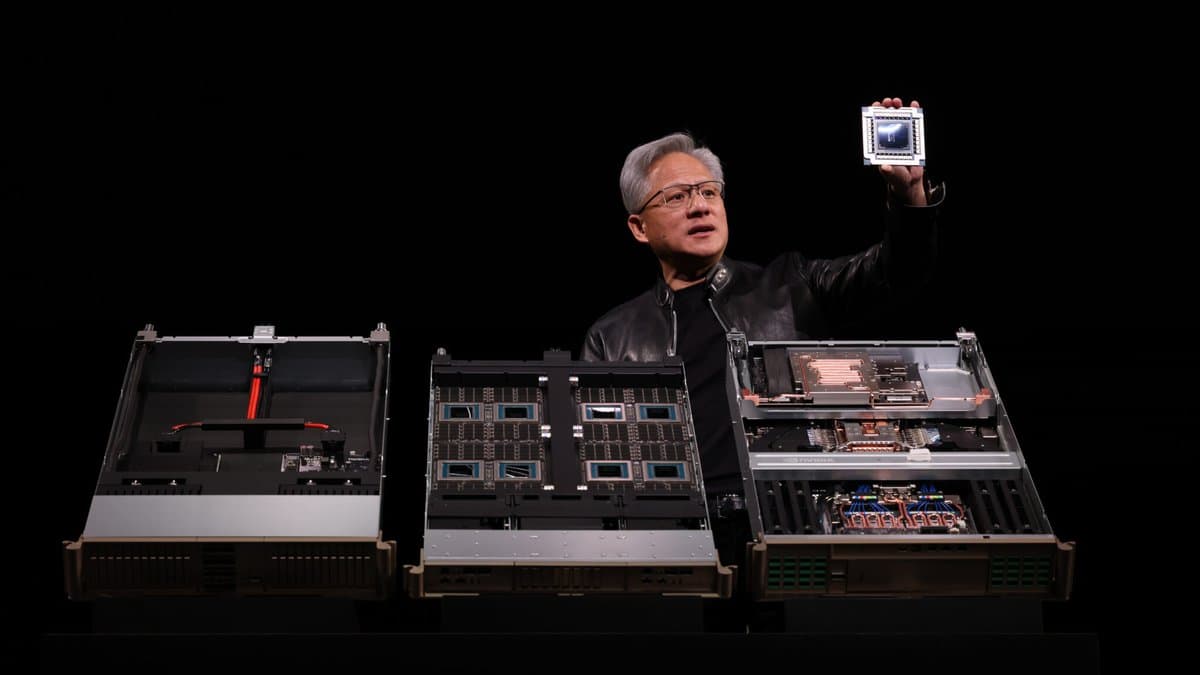
It also matters what Vera Rubin actually is. Nvidia unveiled the platform at GTC on March 16, 2026 — seven new chips and five racks designed to operate as a single supercomputer, with each NVL72 rack pairing 72 Rubin GPUs and 36 Vera CPUs over NVLink 6. Nvidia claims up to 10x the inference throughput per watt versus Blackwell and roughly one-tenth the cost per token for training large mixture-of-experts models. On May 31 the company announced full production, with shipments starting in the fall of 2026.
That timing is the part worth watching. Most Vera Rubin capacity has not been allocated yet, and who gets the early fall units is, in effect, a public ranking of the industry. SSI just walked to the front of that line with no product and no revenue. OpenAI, Anthropic, and xAI bought their places with binding multibillion-dollar contracts and real income statements. SSI bought its place with a name and research nobody outside the building has seen.
What Each Side Is Actually Buying Here
Sutskever's math is easy to follow. SSI's strategy is to sell nothing until it sells the only thing it intends to build, which means revenue is zero and stays zero. A pre-revenue lab doing frontier-scale training has to keep returning to capital markets, and printing another huge equity round on top of a $32 billion mark raises dilution and expectations at the same time. Bringing your compute supplier in as a strategic investor solves cash and hardware in one transaction and buys time before the next raise. And the signal — Nvidia looked at the research and wrote a check — recruits better than ten papers would.
Compute diversification is a real gain on its own. Single-vendor dependence on TPUs carries architectural lock-in risk, and there is a structural priority problem when your compute landlord is also running Gemini against the same silicon. An Nvidia path gives SSI negotiating leverage and, just as importantly, reconnects it to the CUDA software stack that nearly every frontier researcher already knows. When you are hiring, "come here and run a very large cluster on tooling you already use" is a much easier pitch than the alternative.
Nvidia's side has more layers. The surface layer is a reference customer for the next platform generation. Vera Rubin ships this fall, and "Ilya Sutskever made a big bet on this" outperforms any benchmark slide as marketing. Huang's decision to name AlexNet in the release was not sentimental — it was a reminder that the last time Sutskever changed the field, it happened on Nvidia GPUs.
The second layer is buying an option. The scenario Nvidia should fear most is frontier intelligence arriving on silicon it does not make. SSI was already a TPU-first shop. If SSI genuinely breaks something open and it happens on Google's chips, that is damaging to Nvidia both narratively and commercially. Five billion dollars is about 6% of a single quarter's revenue for Nvidia right now. As insurance against that scenario, it is cheap.
The third layer is the contentious one. Nvidia is, at scale, financing the customers who buy its chips. Roughly $100 million into OpenAI's round in October 2024. Participation in xAI's $6 billion round in December 2024. In September 2025, a $6.3 billion cloud capacity agreement with CoreWeave, backing for Mistral's €1.7 billion Series C, and a letter of intent to invest up to $100 billion in OpenAI. In October 2025, Nscale's $433 million SAFE round. In November 2025, up to $15 billion into Anthropic alongside Microsoft, with Nvidia's share up to $10 billion. In 2026: another $2 billion into CoreWeave in January, a $30 billion stake inside OpenAI's $110 billion round in February after the original $100 billion letter of intent lapsed, and $2 billion into Nebius plus participation in a Thinking Machines round in March.
Vendor Financing Has a History — Somewhere Between Lucent and Microsoft
This structure has a name: vendor financing, or in its less flattering framing, the circular deal. The seller funds the buyer, and the funding comes back as a purchase order. History has one very clear failure case. In the late 1990s, Lucent Technologies extended billions of dollars in credit to newly minted telecom carriers so they could buy Lucent equipment, and booked the resulting sales as growth. When the dot-com collapse hit in 2000 and 2001 and those customers could not pay, revenue and asset values fell together, and the stock lost more than 90% from its peak. Nortel walked a similar road.
There is also a very clear success case. Microsoft's $1 billion investment in OpenAI in 2019, which made Azure OpenAI's exclusive compute partner, is the textbook version. A large portion of that money was Azure credits rather than cash. Microsoft ended up holding commercialization rights to the GPT line and booking the cloud revenue from running it. The structure was circular; the outcome justified it. Read charitably, that is the lineage Nvidia is claiming.
Then there is the gray zone, and the gray zone case looks uncomfortably like this one. Inflection AI raised $1.3 billion in 2023 in a round that included both Microsoft and Nvidia, and spent it standing up one of the largest Nvidia clusters in the world. Mustafa Suleyman and Reid Hoffman as founders, elite compute, generous capital — swap the names and you have the SSI setup. In March 2024 Microsoft effectively absorbed the founders and most of the technical staff, leaving a licensing shell behind. Compute and capital did not produce an outcome. It took eighteen months to prove that.
Which of those three roads SSI takes is genuinely unknowable today, and the shortage of evidence is itself the problem. OpenAI had shipped GPT-2 by 2019. Inflection had Pi. SSI has literally nothing an outsider can evaluate. What investors are underwriting is Sutskever's track record plus the private judgment of people who have been in the room with him. Skeptics have not been quiet about it — Michael Burry has described Nvidia's web of investments as a self-reinforcing loop, mocking it as "around and around we go," and Ed Zitron has hammered the same point repeatedly. Nvidia's position is that it does not contractually obligate the companies it invests in to buy its chips.
One more reason for skepticism: the accounting here is deliberately foggy. The deal reportedly mixes cash with compute commitments, but no ratio has been given. If the compute share is large, this is closer to a prepaid sale than to an investment, and it inflates the headline number relative to the economics. On SSI's side, we cannot tell whether the $32 billion mark held, rose, or was quietly written down. Neither company has any obligation to clarify, and at Nvidia's size $5 billion does not trip a separate disclosure threshold. In practical terms, this is a transaction the market cannot audit.
How Google, OpenAI, Anthropic, AMD and Meta Are Running the Numbers Right Now
Google is in the strangest position of anyone. Alphabet is an SSI investor, Google Cloud was SSI's primary compute provider, and DeepMind is chasing the exact same goal SSI exists to reach. SSI opening a large Nvidia lane dilutes its value as the marquee proof that frontier training runs fine on TPUs — a narrative Google has spent years and enormous engineering effort building. Google's response splits two ways: push harder on TPU volume and terms to keep SSI meaningfully on Google silicon, or find a new flagship reference customer for the Ironwood generation somewhere else.
OpenAI will have read this internally as something more personal. Sutskever left. When he says he has research "worthy of scaling up," the implication is that it points somewhere OpenAI's current roadmap does not. But the practical threat remains small for now. OpenAI closed a $110 billion round in February 2026 at a $730 billion pre-money valuation, with Nvidia taking a $30 billion stake, and it has locked in Vera Rubin training and inference capacity under binding contracts. On scale, this is not yet a comparison.
Anthropic's counterplay already happened. In the November 2025 three-way partnership with Microsoft and Nvidia, Anthropic took up to $10 billion from Nvidia and up to $5 billion from Microsoft while committing to purchase $30 billion of Azure compute plus contracted capacity of up to one gigawatt. The arrangement spans Grace Blackwell and Vera Rubin systems and includes joint engineering work to tune Nvidia architectures against Anthropic workloads. Anthropic got the thing SSI just got — eight months earlier and an order of magnitude larger.
AMD and Broadcom read the same announcement differently. The message of this deal is that Nvidia manufactures demand with capital, and that is a brutal game for anyone competing on price-performance. AMD's counter is openness and total cost of ownership against both Nvidia and custom silicon; Broadcom is fighting on an entirely different axis with hyperscaler ASICs. But every deal like this one shrinks the space where a better chip alone can flip an account.
Meta has been playing a different instrument entirely. Zuckerberg tried to buy SSI in 2025, failed, and took co-founder Daniel Gross instead. If you cannot buy the company, buy the people. A capital and compute infusion of this size reduces that poaching pressure for a few quarters. If SSI spends those quarters without a visible result, the pressure comes right back. In frontier labs, compute and capital are tools for retaining talent — they are not, by themselves, results.
So What Actually Changes for You
If you are a developer — almost nothing changes this quarter. SSI is unlikely to publish an API, weights, or a paper, and that is explicit company strategy rather than a delay. The signal worth extracting is different: the allocation order for early Vera Rubin supply is becoming visible. OpenAI, Anthropic, and now SSI are at the front, and that flows directly into GPU rental pricing and availability from late 2026 through the first half of 2027. If you have a large training run planned, moving your cloud reservations earlier is the rational move.
If you are an investor — separate two things. First, Nvidia's own results are still very strong. Fiscal 2027 first-quarter revenue, reported May 20, 2026, came in at $81.6 billion, up 85% year over year, with data center alone at $75.2 billion, up 92%. GAAP diluted earnings per share were $2.39, and guidance for the following quarter was $91 billion. Raising the dividend from $0.01 to $0.25 per share and adding $80 billion in buyback authorization is not the behavior of a nervous management team. Second, no outsider can cleanly separate how much of that growth is demand Nvidia itself financed. Reported tallies of Nvidia's announced investment and capacity commitments in 2026 alone run into the hundreds of billions, which means that when the cycle turns, losses arrive on both the revenue line and the investment portfolio at once. That is precisely how Lucent came apart.
If you buy technology for a company — this is a prompt to reread your vendor relationships. Your compute supplier being a shareholder in your competitors, and in you, is becoming the industry norm, and inside that norm the question of who gets served first starts being settled by cap tables rather than contracts. When you write your next cloud or GPU procurement agreement, be explicit about allocation priority, migration terms at generation transitions, and your right to run a second architecture in parallel. Note that even SSI, with all the leverage a Sutskever company has, chose not to stay on a single silicon vendor.
If you are a regular user — honestly, nothing happens to you right now. SSI has stated it is not building consumer products, and this investment does not produce a service you can use. The larger signal is worth holding onto, though. AI capital keeps flowing away from products that earn money today and toward things that might exist in several years, at a scale comparable to national budgets. If that capital produces results, the tools you use will change. If it does not, a correction arrives somewhere in 2027 or 2028. Either way, not this month.
🥄 Three Things You’re Probably Wondering
— Should I trust the $5 billion figure? Bloomberg and the FT each reported it independently, so it is not invented, but Nvidia's official release contains no amount at all and TechCrunch only went as far as "multiple billions." The cash-versus-compute split has never been disclosed. If the compute portion is large, the economics look more like a prepaid hardware sale than an equity investment, so reading it as $5 billion of cash on SSI's balance sheet is a mistake.
— Is there any evidence SSI has actually built something? No, and that is the honest answer. Since June 2024 there has been no paper, no product, no benchmark, and no demo. Sutskever's own phrase, "research that is worthy of scaling up," is the entire public case, alongside Nvidia's statement that SSI has hit significant research milestones. Nvidia having done diligence is indirect evidence, but Inflection AI enjoyed the same class of endorsement and was hollowed out within eighteen months. Too early to call.
— When do Nvidia's investments in its own customers become a problem? Not while demand is real. The failure mode starts when a funded customer cannot raise its next round — at that moment Nvidia takes an impairment on the investment and loses the revenue at the same time, which is exactly the sequence Lucent lived through in 2000 and 2001. The difference is balance sheet: Nvidia is earning $81.6 billion a quarter with overwhelming cash flow, which is a completely different constitution. Nobody knows when the cycle turns, and most attempts to time it have gone badly.
Further Reading
- Ilya Sutskever's Safe Superintelligence Inc. and NVIDIA Announce Long-Term Strategic Partnership — NVIDIA Newsroom (Jul 27, 2026)
- Ilya Sutskever's Safe Superintelligence partners with Nvidia to scale its AI research — TechCrunch (Jul 27, 2026)
- NVIDIA Announces Financial Results for First Quarter Fiscal 2027 — NVIDIA Investor Relations (May 20, 2026)
- NVIDIA Vera Rubin Opens Agentic AI Frontier — NVIDIA Newsroom, GTC (Mar 16, 2026)
- NVIDIA Vera Rubin Ramps Into Full Production to Power Agentic AI Factories Worldwide — NVIDIA Newsroom (May 31, 2026)
- Microsoft, NVIDIA and Anthropic announce strategic partnerships — Anthropic (Nov 18, 2025)
- Ilya Sutskever: "I am now formally CEO of SSI, and Daniel Levy is President" — X (Jul 3, 2025)
- Ilya Sutskever will lead Safe Superintelligence following his CEO's exit — TechCrunch (Jul 3, 2025)
- OpenAI co-founder Ilya Sutskever's Safe Superintelligence reportedly valued at $32B — TechCrunch (Apr 12, 2025)
- AI startup Safe Superintelligence to use Google's TPU chips for research — Data Center Dynamics (2025)
- Nvidia Funds AI Frenzy: Timeline of Its Circular Financing Deals So Far — Benzinga (Jul 2026)
Numbers and criteria are as of announcement and may change. Investment calls are yours to make!