An American robotics lab's shopping cart just emptied out
Here's a scene that repeats itself every semester in American robotics labs. A grad student needs a quadruped for a locomotion paper. The department gives them a few thousand dollars. Boston Dynamics' Spot is out of the question — it launched in 2020 at $74,500 and configured units run higher. So they buy a Unitree. IEEE Spectrum reviewed the Go1 at $2,700 back in 2021, and everything since has gotten cheaper or better. It ships with ROS2 support, a documented Python and C++ SDK, and a GitHub ecosystem stuffed with other people's reinforcement-learning gait policies and SLAM stacks. A substantial share of American robotics research runs on Chinese hardware. Everyone in the field knows this. Nobody wrote it down as a risk.
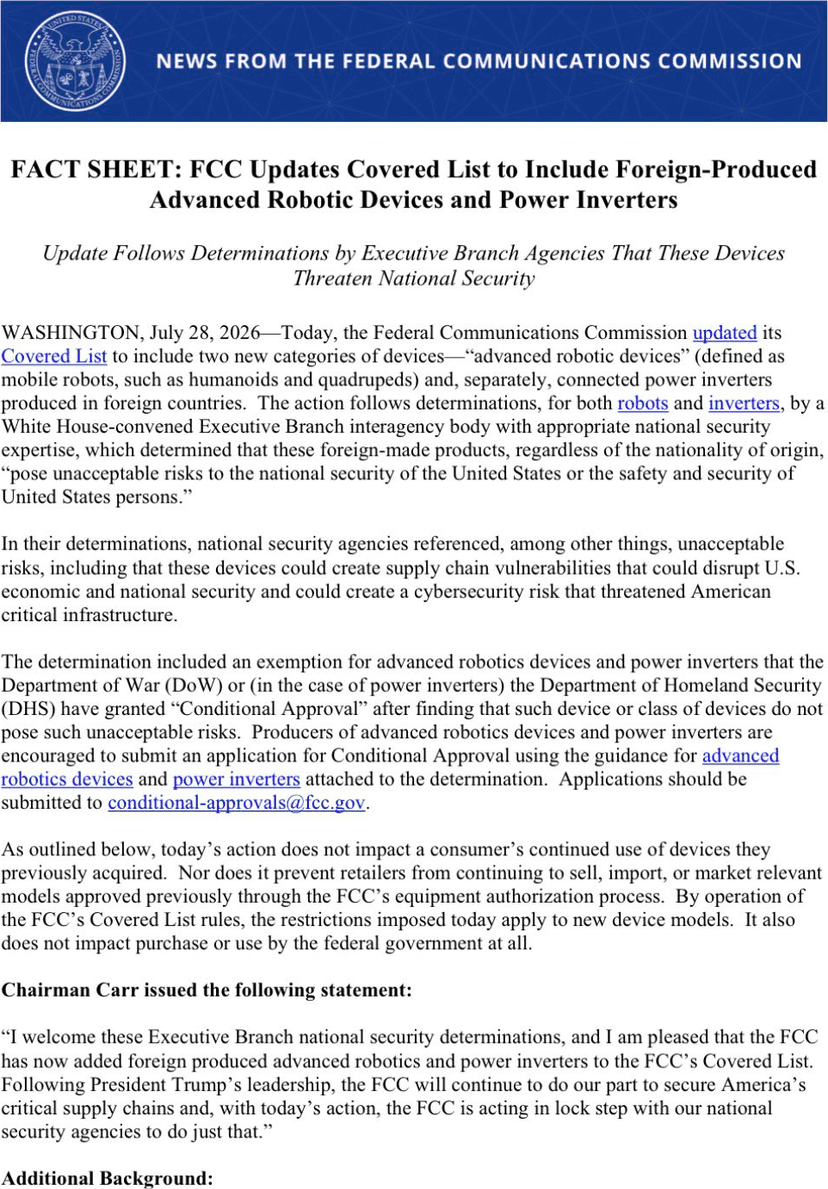
Then on July 28, 2026, the FCC's Public Safety and Homeland Security Bureau published a short public notice, document number DA 26-786. It adds two categories to the Covered List: foreign-produced "advanced robotic devices" and foreign-produced power inverters. Once something lands on the Covered List, it cannot receive new FCC equipment authorization. No authorization means no import, no marketing, no sale in the United States. The notice took effect the day it was released.
What counts as an "advanced robotic device"? The FCC's fact sheet describes them as mobile robots such as humanoids and quadrupeds. Two legs or four legs. Which means the two form factors the entire physical-AI boom is currently built around just got fenced off in one paragraph. Power inverters — the boxes that connect solar panels, batteries, and data center power gear to the grid — got fenced off in the same document.
The interesting part isn't the ban. It's the grammar of the ban. The Covered List used to be a list of company names: Huawei, ZTE, Hikvision, Dahua, Hytera. These new entries name nobody. The text reads "Foreign-produced advanced robotic devices," with an exception only for products granted a Conditional Approval by the Department of War. Not a bad-actor list. A bad-geography list. And the geography isn't "China" — it's "foreign." That one word does a lot of work, and we'll come back to it.
So here's what this piece is actually about: how a rule built to keep Huawei out of cell towers ended up regulating robot legs, whether the Conditional Approval escape hatch is a real door or a painted one, what American buyers are supposed to purchase when China makes 85 to 90 percent of the world's humanoids, and how durable that "existing models are fine" carve-out really is.
Who's actually in this fight
Start with the FCC, and with a detail most coverage skipped: the FCC did not decide this. The governing statute, the Secure and Trusted Communications Networks Act of 2019 (47 U.S.C. §§1601-1609), deliberately prevents the Commission from editing the Covered List on its own. National security determinations come from executive branch agencies; the FCC is the enforcement window that writes them into the list. In this case a White House-convened interagency body issued the determination, and the FCC transcribed it. Chairman Brendan Carr said in his statement that he welcomed the executive branch determinations and that, following President Trump's leadership, the FCC would keep doing its part to secure America's critical supply chains.
The second set of players hold the exceptions. Per the FCC notice, Conditional Approval for robots is evaluated by the Department of War — the Defense Department's current official name. For power inverters, either the Department of War or the Department of Homeland Security can grant it. The carve-out is written directly into the Covered List entry itself, which means a foreign manufacturer that clears review can still enter the US market. The FCC pointed applicants to conditional-approvals@fcc.gov. What it did not publish: how long review takes, what evidence it demands, or whether Chinese firms can realistically use it. That's genuinely unknown right now, and anyone telling you otherwise is guessing.
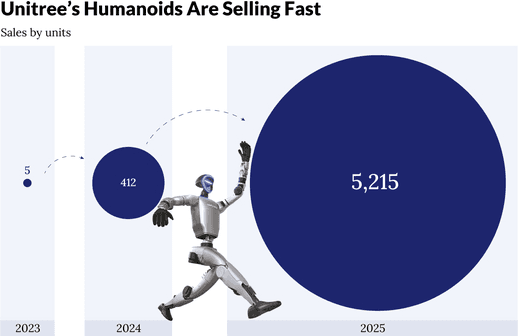
Third: the companies on the receiving end. The scale explains why this is a big deal. Per AP reporting, China holds roughly 85% of the global humanoid robot market; Rest of World's tally puts Chinese firms at around 90% of global sales. Somewhere between 13,000 and 18,000 humanoids shipped worldwide in 2025. Unitree shipped 5,500 of them. AgiBot shipped 5,168. Two companies, more than half the planet. Unitree is also the de facto default in quadrupeds, and TrendForce reports it has committed to capacity expansions of 75,000 humanoids and 115,000 quadrupeds per year. TrendForce projects Chinese humanoid output will grow 94% in 2026, with Unitree and AgiBot together taking close to 80% of shipments.
Fourth: the American bench. The names floated as beneficiaries are Tesla, Figure AI, Agility Robotics, Boston Dynamics, and Apptronik. The problem is weight class. By Rest of World's count, Figure, Agility, and Tesla's Optimus each shipped roughly 150 units in 2025 — about 3% of Unitree alone. Tesla set a 5,000-unit production target for 2025 and missed it, with public sales now pointed at late 2027. Elon Musk himself has said China is very good at AI and very good at manufacturing and will be Tesla's toughest competition. Translation: no American company can backfill this supply gap today. Not close.
Fifth, and easy to miss: the Pentagon was already treating Unitree differently. On June 8, 2026, the Defense Department updated its Section 1260H list of "Chinese military companies" with 65 new entities, Unitree among them. The list now runs to 188 companies and includes Alibaba, Baidu, and BYD. The formal effect of 1260H is a bar on Defense Department contracting, but the practical effect is a government-wide signal flare. The FCC action landed six weeks later. Reading it as the next step in the same sequence is the natural reading.
What the document actually says
The Covered List language is dry. Two new lines: foreign-produced power inverters, except those granted a Conditional Approval by DoW or DHS; and foreign-produced advanced robotic devices, except those granted a Conditional Approval by DoW. That's it. No company. No country.
The reasoning sits in the fact sheet. On inverters, the executive branch found two unacceptable risks: a supply chain vulnerability that could disrupt US economic security including sectors critical to national security, and a cybersecurity risk threatening critical infrastructure and the safety of US persons. On robots, the finding is that the networked capabilities of advanced robotic systems create extensive vulnerabilities and attack vectors that can manipulate both the data and the physical operation of the system. Carr added that these robots collect data that could be leveraged by malign actors to surveil Americans.
The inverter half of that argument has receipts. In May 2025, Reuters reported — and energy trade press including Utility Dive covered in detail — that US experts tearing down grid-connected Chinese solar inverters found communication components listed nowhere in the product documentation, specifications, or bills of materials. Some included cellular radios. Similar undocumented hardware turned up in batteries from multiple Chinese suppliers. Those parts create an out-of-band channel that can walk straight around a utility firewall. Utility Dive reported that operators including Florida Power & Light began moving away from Chinese inverters, and that Lithuania passed a law restricting remote access to large-scale solar and battery installations. The inverter entry is built on a documented incident.
The robot half is not, at least not publicly. What the released documents contain is a general proposition about networked capability creating attack surface. No specific backdoor discovery in a specific robot appears in the FCC materials. The underlying classified determination may well contain more. But on the public record, the two entries are supported at very different evidentiary densities, and that gap is exactly the kind of thing that gets litigated or argued over inside a Conditional Approval review.
| Item | Detail | Source of record |
|---|---|---|
| Notice / effective date | July 28, 2026 (most coverage dated July 29) | FCC Public Notice DA 26-786 |
| Categories added | Foreign-produced advanced robotic devices (humanoid, quadruped); foreign-produced power inverters | FCC Covered List |
| Legal authority | Secure and Trusted Communications Networks Act (47 U.S.C. §§1601-1609) | FCC notice |
| Who decided | National security determination by a White House-convened interagency body | FCC fact sheet |
| Exception review | Robots → Department of War; inverters → DoW or DHS | FCC notice |
| Scope | New equipment authorizations only — previously authorized models, already-purchased devices, and federal government use are excluded | FCC fact sheet |
| China's humanoid share | ~85% of market (AP) / ~90% of sales (Rest of World) | AP, Rest of World |
| 2025 global humanoid shipments | ~13,000–18,000 units | Rest of World |
| Unitree / AgiBot 2025 shipments | 5,500 / 5,168 units | Rest of World |
| Figure, Agility, Tesla — each | ~150 units | Rest of World |
| Unitree capacity commitments | 75,000 humanoids and 115,000 quadrupeds per year | TrendForce |
| China 2026 output forecast | +94% year over year | TrendForce |
| China humanoid market forecast | $15B by 2030 (Morgan Stanley estimate) | AP |
| Unitree Shanghai IPO | Filed March 20; targeting ~RMB 4.2B ($610M) | Rest of World |
| Pentagon 1260H listing | Unitree added June 8, 2026; list now 188 entities | DoD / WilmerHale analysis |
The row people will misread is scope. This is not a recall. A Unitree G1 or Go2 that already holds FCC authorization can still be sold, and anyone who already owns one can keep using it. Federal government purchase and use are carved out entirely. No American lab's shelf empties this week.
The problem is the next model. Robotics refresh cycles are far shorter than telecom equipment cycles. Unitree ships new hardware annually, cuts prices, raises specs. Blocking new authorizations means the generation currently on sale is the last generation for the US market. The hardware stays; the roadmap stops. If you're scoping a three-year deployment — a warehouse pilot, a research program, a product line — that's nearly as heavy as a recall.
Who gets what out of this
The clearest winners are American robot makers, but be precise about the nature of the win. This isn't "we beat them on price." It's "the price comparison stopped existing." The hardest question US robotics founders faced from investors was some version of: what happens when Unitree sells something comparable for a fifth of your price? Inside the US market, that question is now moot. Figure, Agility, Apptronik, and Hyundai-owned Boston Dynamics get to compete on lead times, support, and procurement fit instead. Build in America and the rule doesn't touch you, because you aren't foreign-produced.
Second winners: non-Chinese manufacturers with US production, or the ability to move it. And here's where that one word bites. The entry says foreign-produced, not Chinese-produced. Read literally, a humanoid or quadruped built in Japan, South Korea, Germany, or Canada also cannot get US authorization without a Conditional Approval. How that gets enforced in practice is not yet established, and it's entirely plausible that allied-country products sail through review as a formality. But the text on the page doesn't distinguish by nationality, and that's worth saying out loud. If your company assembles robots in Seoul or Nagoya and sells into the US, this is not someone else's news story.
Third, quietly: American power electronics. Solar inverters have been a Chinese price-dominated category for years, and demand is exploding right now because data center buildout is a power-equipment story before it's a chip story. Cutting off new Chinese authorizations doesn't raise a barrier; it draws a line. The flip side is real, though — pricier inverters mean pricier solar projects, which flow through to electricity rates and data center capex.
Now the losers. Unitree and AgiBot obviously, though how much they actually depend on US revenue is a separate question. Domestic China plus Europe and Asia are much bigger markets for them, and multiple outlets reported Unitree began commercial sales in Europe on July 22. Its Shanghai STAR Market listing is in motion, targeting roughly RMB 4.2 billion ($610 million) as of the March 20 filing. Losing America doesn't destabilize the company. If anything, "the firm America is scared of" is a decent story to tell Chinese retail investors during an IPO.
The second group of losers is where the real damage lands: American robotics researchers and small logistics and facilities operators. A university lab that ran experiments on a $2,000–4,000 quadruped now has to price the same experiment on equipment an order of magnitude more expensive. A small warehouse operator planning a cheap automation pilot faces the same math. And it isn't only cost — it's ecosystem continuity. A large body of robot-learning research has accumulated on a handful of low-cost platforms, reproducible because everyone had the same $3,000 machine. Cut off the next generation of that platform and code, datasets, and baselines start drifting apart. Reproducibility broken by trade policy is a genuinely strange failure mode.
We've seen this movie before
The template is Huawei and ZTE. On March 12, 2021, the FCC put Huawei, ZTE, Hikvision, Dahua, and Hytera on the Covered List for the first time, resting on equipment Congress had already flagged in section 889 of the FY2019 NDAA. Then the Secure Equipment Act was signed on November 11, 2021, obliging the FCC to stop even reviewing authorization applications for covered gear. On November 25, 2022, the Commission adopted rules prohibiting new equipment authorizations on national security grounds — the first time in its history it had done so. Same three-beat structure as the robot action: list it, block new authorizations, seal off import and sale.
What worked: keeping new gear out. Huawei network equipment effectively vanished from new US deployments, and the surveillance camera vendors followed the same path. On its first-order goal, the framework delivered.
What failed was everything after. Nobody had honestly costed removing what was already installed. Congress appropriated $1.9 billion in 2021 to reimburse small and rural carriers for ripping out and replacing Huawei and ZTE gear; actual claims came to roughly $4.9 billion. The $3.08 billion hole sat open for years, dragging carriers into limbo, until a spectrum bill folded into the December 2024 NDAA let the FCC borrow from the Treasury. The FCC drew the funds in March 2025, to be repaid out of a spectrum auction that started June 2, 2026. Five years from ban to funded fix. The lesson is blunt: a prohibition takes a day, and replacement takes half a decade. The explicit "we are not touching existing devices" language in the robot order reads like a direct application of that lesson.
The second precedent is drones, and it's the more ominous one. Section 1709 of the FY2025 NDAA required a designated national security agency to assess Chinese-made drones by December 23, 2025 — and specified that if no assessment happened, the products would be added to the Covered List automatically. No agency ever started the review. DJI spent the year publicly begging for the audit it was supposed to receive. On December 22, 2025, the FCC added all foreign-produced uncrewed aircraft systems and UAS critical components to the Covered List. The listing didn't happen because a review found something; it happened because the statute was built so that silence equals listing. Apply that directly to the robot order: Conditional Approval exists on paper, but whether a door exists and whether anyone is staffed to open it are two different facts.
Third, look at the sequence itself. Foreign-produced drones on December 22, 2025. Foreign-produced routers on March 23, 2026. Foreign-produced robots and inverters on July 28, 2026. Three additions in eight months, every one of them keyed to where a thing is made rather than who makes it. The Huawei-era bad-company list has become a bad-origin list. And one more thing sits underneath: on July 22, 2026, the FCC adopted a Third Report and Order in ET Docket 21-232 addressing procedures to block further importation and marketing of already-authorized covered equipment while still permitting continued use. Today's grandfather clause does not guarantee tomorrow's. That's the most underweighted fact in this whole story.
How the other side punches back
Beijing's opening move is already on the record. Foreign Ministry spokesperson Mao Ning said protectionism does not make the US more competitive and will only hurt the interests of US companies and consumers. The Chinese embassy told the US to stop smearing Chinese companies and threatening them with sanctions, and said Beijing would take all necessary measures against anything causing material harm to its interests. That's boilerplate until you remember what leverage actually exists. Humanoids depend on high-performance permanent magnets, precision reducers, and actuators, and those supply chains still tilt heavily toward China. A country that blocks finished-goods imports and then eats a component export restriction has done itself a complicated favor.
Unitree and AgiBot will most likely respond by redistributing, not fighting. If America closes, you push into Europe, the Gulf, Southeast Asia, and above all the Chinese domestic market, where industrial policy support and provincial procurement can absorb a lot of units on their own. Be honest about what this ban produces: an America that can't buy Chinese robots, not a China that can't sell them. The Huawei experience showed that market exclusion tends to make a company more entrenched elsewhere rather than dead.
Third counter-route: the Conditional Approval window itself. Textually it isn't nationality-scoped. A Chinese manufacturer submitting source code, bills of materials, and remote-access architecture to the Department of War and clearing review is not formally impossible. For Unitree specifically it's implausible, given the 1260H listing. But smaller Chinese manufacturers not on 1260H, or Chinese-backed entities incorporated in Southeast Asia or Europe, could plausibly try the window. The FCC published no processing standards or timelines, so whether the window is genuinely open cannot be determined right now.
Fourth: designing around the line. This rule targets form factors — humanoid and quadruped. Wheeled autonomous mobile robots, robot arms, parcel sorters, and delivery bots are not explicitly named. Whether the Chinese service robots already common in US warehouses and hospitals are captured is unclear from the public text. When you draw a regulatory boundary at a form factor, manufacturers change the form factor. Take off the legs, add wheels; change the leg count; ship a torso on a base. Telecom gear couldn't dodge like that. Robot morphology is a design variable, and regulators will be chasing it.
Finally, the American side's actual homework. This order bought time, not victory. If Unitree sold 5,500 units in 2025 while three US firms sold roughly 150 each, the gap isn't priced in dollars, it's priced in manufacturing scale. Protection that doesn't get converted into scale produces exactly one outcome: an expensive, slow domestic industry five years later that still can't compete abroad. The US solar industry ran that exact experiment. The task for Figure, Agility, Apptronik, and Tesla over the next few years isn't enjoying a competitor-free market — it's cutting per-unit cost by an order of magnitude before the window closes.
So what actually changes
For ordinary consumers, almost nothing immediate. This is an authorization block, not a recall, so a robot dog or humanoid you already own keeps working and support continues in principle. Legless machines — robot vacuums, robot mowers — aren't named in the order. Two things are worth filing away, though. If you were planning to buy a legged robot next year, expect fewer options at higher prices. And note that power inverters got bundled into the same action: if you're planning residential solar or home battery storage, component sourcing and pricing could move over the next few quarters.
For developers and researchers, this is more urgent. Step one is checking whether your current platform holds an existing FCC authorization — if it does, buying and using it is fine today. Step two is the next generation, which is the part that breaks. If a three-year research program or product roadmap is built on that hardware, now is the moment to evaluate alternatives in parallel rather than after the fact. Step three, and honestly the highest-leverage one: decouple your software from your hardware. Simulation environments, control stacks, and training pipelines that are welded to one vendor's SDK make platform migration catastrophically expensive. This episode is a very concrete demonstration that hardware vendor lock-in is now a geopolitical risk, not just an engineering preference.
For investors, three things. First, the valuation logic for US humanoid startups just changed. Their biggest overhang was Chinese price pressure, and inside the US that's been removed — replaced by a new risk, which is failing to build scale inside a protected market. Second, watch components. When finished goods get blocked, the next front is usually actuators, harmonic reducers, and permanent magnets, and anyone with a non-Chinese supply chain in those categories gets repriced. Third, retroactivity risk is real: ET Docket 21-232 is literally about procedures for later blocking import and marketing of already-authorized covered equipment. Building a business plan on the assumption that grandfathered models stay grandfathered is a bet, not a baseline.
For policy people outside the US, run your own country through the text. The rule says foreign-produced. A robot built in Korea, Japan, or Germany is textually in scope, and the way out is a Department of War Conditional Approval whose requirements and timelines have not been published. If you're an exporter, the question to be asking your counsel this month isn't about tariff rates — it's what a Conditional Approval submission requires, and very few people currently know the answer. It's also worth tracking what comes next on this list. Drones, routers, robots, inverters in eight months. On the current trajectory, the candidate pool is "anything that connects to a network and touches the physical world."
🥄 Three Things You're Probably Wondering
— So what does this mean for me? Directly, not much. Nobody's confiscating a robot you already bought, and there's no effect on sales outside the US. It matters if you work at or invest in a company that sells robots or robot components into America — because the rule says "foreign-produced," not "Chinese-produced," which textually sweeps in allied manufacturers too.
— Why is this happening right now? It's not a bolt from the blue, it's the next item in a sequence: foreign-produced drones in December 2025, foreign-produced routers in March 2026, robots and inverters in July 2026. Six weeks before this order, the Pentagon added Unitree to its Chinese military companies list. And the inverter half rests on May 2025 reporting that Chinese solar inverters connected to US grids contained communication hardware listed in no product documentation. This is the Huawei-era framework being extended to hardware that moves.
— Does this mean American robots now win? Too early to call. Closing a market and improving a product are different projects. In 2025 Unitree shipped 5,500 units and AgiBot 5,168, while Figure, Agility, and Tesla each shipped around 150. What US firms got was a few years of runway, not a win — and if they don't close the manufacturing and cost gap inside that window, the outcome is a protected industry that's expensive and slow. American solar already ran that experiment and we know how it ended.
Sources
- FCC Public Notice DA 26-786 — Foreign-produced power inverters and advanced robotic devices added to the Covered List (July 28, 2026)
- FCC Fact Sheet — Covered List update details
- FCC — FAQs on the Covered List updates for robots and inverters
- FCC — List of Equipment and Services Covered by Section 2 of the Secure Networks Act
- Chairman Brendan Carr's announcement post on the two new categories
- FCC Third Report and Order, ET Docket 21-232 — limiting previously authorized covered equipment
- AP via PBS NewsHour — US bans foreign-made humanoid robots, targeting China over national security
- Al Jazeera — US bans imports of new Chinese robots over security concerns
- NBC News — US bans foreign-made humanoid robots, targeting China
- Rest of World — China is winning the humanoid robot race while Tesla's Optimus lags
- Rest of World — Unitree files for $610 million Shanghai IPO
- TrendForce — China's humanoid output to surge 94% in 2026; Unitree and AgiBot to capture nearly 80% share
- WilmerHale — Pentagon adds 65 new entities to the 1260H list of Chinese military companies
- Mayer Brown — Foreign-produced UAS and critical components added to the FCC's Covered List (Dec 2025)
- Mayer Brown — FCC expands its Covered List to include foreign-produced routers (March 2026)
- Mayer Brown — FCC bans approval of new telecommunications equipment for entities on the Covered List (Nov 2022)
- CSET — FCC bans sale of new devices from Chinese companies Huawei, ZTE and others
- Congressional Research Service — New FCC rules ban authorizations for equipment posing national security risks
- Utility Dive — 'Rogue' communication devices found on Chinese-made solar power inverters
- IEEE Spectrum — Unitree's Go1 robot dog looks pretty great, costs just $2,700
Numbers and criteria are as of announcement and may change. Investment calls are yours to make!