They're putting an entire rack into orbit
Here's the deal: SpaceX's August 4 announcement comes down to two sentences. First, all future SpaceX AI infrastructure will be built exclusively on Nvidia architecture. Second, SpaceX and Nvidia are jointly designing the compute payload for Starmind AI1, a satellite that runs AI workloads from low Earth orbit.
Musk's phrasing left no wiggle room, as usual. "We've decided to build exclusively on Nvidia, because we think the Vera Rubin architecture is the best architecture." A company that effectively dominates the global launch market just said publicly that every unit of compute it puts into space will come from one vendor. The Register's headline captured it: Elon pledged to give Nvidia a virtual monopoly over the stars.
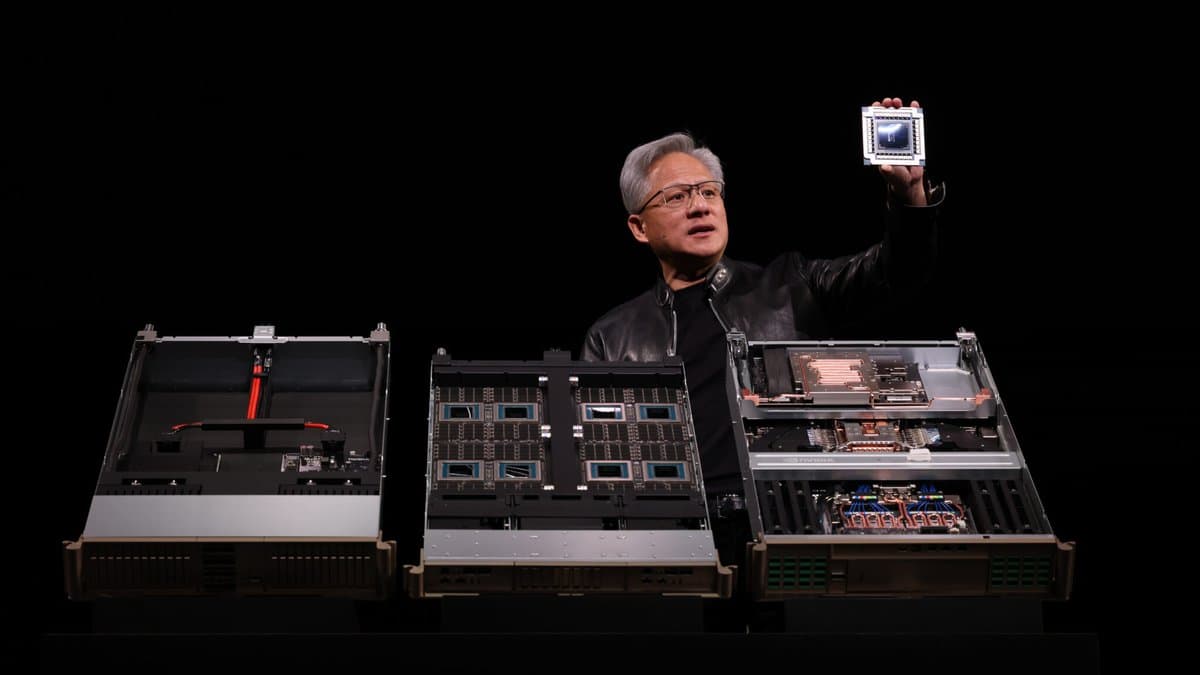
The numbers are what make this a technology story rather than a procurement story. Each Starmind AI1 carries the equivalent of a full Nvidia Vera Rubin NVL72 rack — 36 Vera CPUs and 72 Rubin GPUs. That's the same configuration that occupies a rack slot in a terrestrial data center, packed inside a satellite bus. To make it work, SpaceX raised AI1's peak power by 67% to roughly 250 kW, and lifted average continuous power 33%, from 120 kW to 160 kW.
If 250 kW doesn't land, frame it this way. A Starlink satellite typically operates in the single-digit kilowatt range. Starmind generates and consumes two orders of magnitude more power in orbit — and has to dump all of that heat into vacuum. This is not a communications satellite. It's a flying server rack.
SpaceX, Nvidia, and what Starmind actually is
SpaceX brings the launch vehicle, the satellite bus, and above all the cost of getting mass to orbit. The critical asset is that it already mass-produces and operates thousands of satellites via Starlink. Orbital data centers have been proposed by plenty of people; exactly one company is already in the business of building satellites at volume and launching them on its own rockets. The production line, electric propulsion, and optical inter-satellite laser links learned on Starlink carry straight over to Starmind.
Nvidia gets revenue, obviously, but the bigger prize is the standard. Vera Rubin ships as an NVL72 rack-scale unit pairing Vera CPUs with Rubin GPUs, and if SpaceX adopts that rack form factor as the orbital baseline, the software stack for space compute starts on CUDA. What happened on the ground repeats above it. Nvidia stock rose 4% to $221.33 on the announcement.
Starmind AI1 is, as the name implies, the first article. The disclosed plan is prototype testing in early 2027 and mass production later that year. The end-state SpaceX describes is a constellation of up to one million AI satellites, each acting as a distributed compute node. Worth being blunt: that million is a vision slide today. Starlink took more than a decade to reach roughly ten thousand.
So why orbit? Three reasons. Power first — the bottleneck for terrestrial AI data centers stopped being GPUs and became grid interconnection. In several US states, the queue for new large-load interconnects runs years. In orbit, sunlight arrives without atmospheric attenuation, and in the right orbit it arrives 24 hours a day. Cooling water second: water consumption is already a political flashpoint for data centers, and space cooling is radiative, meaning zero water. Land and permitting third: nobody in orbit files a zoning objection.
What's actually hard about this
| Item | Starmind AI1, as disclosed |
|---|---|
| Announced | August 4, 2026 (SpaceX + Nvidia) |
| Compute payload | Equivalent to Nvidia Vera Rubin NVL72 — 36 Vera CPUs + 72 Rubin GPUs |
| Peak power | ~250 kW (up 67% from prior design) |
| Average continuous power | 160 kW (up 33% from 120 kW) |
| Prototype | Testing planned for early 2027 |
| Mass production | Targeted for late 2027 |
| Long-term vision | Constellation of up to 1 million AI satellites |
| Supply policy | SpaceX AI infrastructure Nvidia-exclusive |
| Market reaction | Nvidia +4% ($221.33) / AMD −6% to −9% |
The heaviest rows in that table are the two power lines. Drawing 250 kW in orbit means solar array area far beyond any Starlink generation — and it means rejecting close to 250 kW of heat into vacuum. Terrestrial data centers move heat with air or water. Space has no medium to move it into, so the only path is radiation. Radiated power scales with radiator area and the fourth power of surface temperature, which means raising electrical power forces radiators to grow sharply or forces chips to run hotter. The number one practical difficulty in orbital data centers isn't launch cost. It's this.
Second problem: radiation. Terrestrial HBM and logic are vulnerable to single-event upsets in the space environment. Low Earth orbit is far kinder than deep space, and the working hypothesis in this field is that commercial off-the-shelf parts can survive if you manage regions like the South Atlantic Anomaly carefully. But that hypothesis has been validated at the scale of a few H100s. Running 72 GPUs as a rack, fault-free, for years is a different problem — and when something breaks, nobody is going up to swap it.
Third: data movement. Training in orbit means training data has to go up and results have to come down. Inter-satellite laser links are proven on Starlink, but total ground-to-orbit bandwidth still doesn't compare to fiber. That makes the realistic first use case not large-scale pretraining but processing data that was generated in orbit in the first place — Earth observation imagery analysis — plus inference. China's orbital compute program was designed on precisely that logic, which is instructive.
Fourth, and least discussed: economics. For orbital compute to beat terrestrial, three variables have to land in a specific combination — cost per kilogram to orbit, satellite service life, and the price of terrestrial power. Starship, operating normally, crushes the first variable. But satellite life is short, on the order of three to five years, and during that window terrestrial GPUs turn over a generation roughly every two years. Depreciation runs faster in orbit, and nobody has solved that yet.
Who gains
The obvious winner is Nvidia. Beyond the revenue, "the only architecture SpaceX flies" becomes the reference point for every entrant that follows. Anyone designing a satellite compute payload will look at the configuration SpaceX validated, and that configuration runs CUDA. The move Nvidia has executed on the ground for fifteen years — sell hardware, make the software ecosystem the standard — now has the conditions to repeat in orbit.
SpaceX gets self-generated launch demand, and that's the commercial core of the announcement. As with Starlink, SpaceX is strongest when it is its own largest customer. You don't have to take the million-satellite figure at face value; getting a few percent of the way there still fills Starship's cadence. And with xAI inside the same orbit of companies, orbital compute arrives with an internal consumer already attached.
AI infrastructure investors get a new valuation axis. For two years the bottleneck has been power, and the market has attached premiums to nuclear, gas turbines, and interconnection rights. If orbital compute becomes credible, part of that premium migrates to launch capacity and satellite manufacturing. That the narrative alone moves multiples was demonstrated this week.
AMD took the immediate hit. AMD reported the largest quarter in its history the same week and the stock fell 6–9% anyway. The cause wasn't earnings — it was this announcement. AMD has been positioning the Instinct MI450 family as the hyperscaler alternative, and SpaceX's exclusivity declaration is a public rejection of that pitch. In actual revenue terms, SpaceX's space-bound volume is likely smaller than a single hyperscaler's terrestrial order. The market bought the symbol, not the invoice.
For terrestrial data center operators, this is harmless now and uncomfortable later. Orbit does not replace ground today. But if "we can't build because there's no power" persists for a few more years, capital will find alternate routes. What this announcement did is formally register orbit as one of those routes.
The question nobody asks — who governs the orbit?
Buried under the technology and economics is a problem that arrives the instant someone says "one million satellites": orbital resources and regulation.
Start with spectrum and launch licensing. Putting satellites in orbit requires frequency coordination through the ITU and, in the US, constellation authorization from the FCC. Starlink went through that process repeatedly, drawing competitor objections and conditional approvals along the way, and Starmind will follow the same path. But Starmind isn't a communications satellite — it's a compute satellite, and it doesn't map cleanly onto existing regulatory categories. Which country's law applies to a facility processing data in orbit is a question without a settled answer.
That isn't abstract. Multiple legal regimes — Europe's GDPR, Korea's personal data protection law — specify the physical location of data, and orbit is nobody's territory. Whether nations pursuing sovereign AI would permit their data to be processed in orbit, or specifically prohibit it, is unknown right now. It's also why people frequently suggest the first customers for orbital data centers won't be commercial enterprises but militaries and intelligence agencies. For them, jurisdictional ambiguity isn't a bug.
Second is orbital congestion. Low Earth orbit already holds tens of thousands of satellites, and the scale Starmind describes multiplies that. Kessler syndrome — collision debris triggering cascading collisions — has long been a theoretical concern, but the math shifts as density rises. And Starmind satellites must deploy solar arrays sized for 250 kW, giving them large cross-sections. Large cross-section means higher collision probability, and that's physics, not something you negotiate around.
Third is astronomy. Starlink's large-scale deployment drew sustained objections from astronomers about interference with ground-based observation, and SpaceX applied several rounds of reflectivity mitigation. Satellites with large radiators and solar arrays, like Starmind, make that worse. As a commercial risk it's small, but it will keep appearing as an argument in regulatory proceedings.
To summarize: the bottlenecks for orbital data centers, in order, are heat, radiation, depreciation, and regulation. Technical announcements address the first two, business plans reach the third, and the fourth usually doesn't get discussed until after the first satellite is up.
Starlink succeeded. Iridium went bankrupt.
Space infrastructure offers both a clean success and a clean failure. Start with the failure. Iridium built a 66-satellite global satellite phone network in the 1990s, launched service in 1998, and filed for bankruptcy protection nine months later. The technology worked. The handset was a brick, calls cost several dollars a minute, and — decisively — terrestrial cellular networks got built out far faster in the meantime. The lesson: space infrastructure competes against the improvement rate of the terrestrial alternative. Orbital data centers inherit that exact exposure. The thesis holds only if terrestrial power constraints stay unsolved for several more years.
The success case came from the same company. Starlink made the opposite choice from Iridium at every fork: build satellites cheaply at volume, internalize launch cost by flying your own rockets, and design around short lifespans with continuous replacement. The result broke the assumption that satellite internet is slow and expensive. Starmind copies that formula line for line — cheap, many, own rockets, short life assumed. Reusability is precisely why SpaceX starts this race ahead of everyone else.
The third reference is still running: China. The CASIC-affiliated Three-Body Computing Constellation launched its first twelve satellites in 2025 and has since completed nine months of in-orbit testing, reporting that it ran large AI models directly on satellite hardware. Concrete numbers came with it: two satellites held an optical laser link for 192 hours, 8 minutes, 45 seconds at separations up to 1,000 km, with 99.99% link availability. The plan calls for 2,800 satellites by 2028 and a combined 1,000 POPS of compute. Orbital compute is not a couple of American companies' idea — it already has a national program attached.
Overlay those three and Starmind's real risk becomes visible. The likely failure mode is not technical impossibility. It's the terrestrial alternative getting cheap first, or depreciation eating the economics.
How the competition answers
Google is already on the board. Project Suncatcher, unveiled in November 2025, is a moonshot to validate orbital compute using Google's own TPUs on solar-powered satellites. Working with Planet Labs, it will fly two satellites in early 2027, each carrying four TPUs, to test hardware survival in orbit and validate optical links for real machine learning workloads. The accompanying paper sketches a cluster of 81 satellites within a 1 km radius. Google's approach is far more cautious and validation-driven than SpaceX's — but by going with its own silicon, it's the only substantive counterexample to Nvidia's orbital lock-in.
Starcloud is smaller but ahead on the calendar. It launched Starcloud-1 carrying an Nvidia H100 in November 2025, and Starcloud-2, slated for October 2026, will carry several H100s alongside Blackwell platform hardware. Long term, the company has floated a 5 GW data center across a 4 km solar array. Starcloud matters because it already proved you don't have to be SpaceX to attempt orbital compute — though depending on someone else's rockets is a structural weakness.
AMD's counter will most likely come on the ground. Fighting Nvidia head-on for space-qualified volume has poor economics right now. The rational play is to keep winning terrestrial hyperscaler sockets with the MI line and keep the total-cost-of-ownership argument running on performance per watt. AMD's data center revenue growing 107% this quarter is itself ammunition for that argument.
Amazon and Blue Origin are the only other group that could replicate this exact combination — a satellite constellation (Kuiper), a launch vehicle (New Glenn), and a demand sink (AWS) under one roof. The gap is timing: neither Kuiper's deployment pace nor New Glenn's cadence is at Starlink/Falcon 9 levels. If that group commits seriously, orbital compute becomes a two-horse race overnight.
The last counter-play is the most boring and the most powerful: just solve terrestrial power. Small modular reactors, gas turbine buildout, streamlined interconnection queues, and geographic relocation of data centers toward stranded generation. If any one of those moves faster than expected, much of the economic case for orbital compute weakens. The biggest competitor to an orbital data center isn't another satellite — it's a power plant in Texas.
So what actually changes
For regular users, nothing changes before 2027. With prototype testing in early 2027 and production after that, real service workloads running in orbit are several years out at minimum. The significance of this news is directional, not product-level: the bottleneck in AI infrastructure has moved from chips to power so completely that it has now spilled into satellite launch plans.
For developers and infrastructure engineers, there's one practical implication. If orbital compute commercializes, the first workloads will be latency-insensitive and data-movement-light: large batch inference, on-site processing of satellite-generated data, offline fine-tuning. Interactive services and low-latency APIs stay on the ground for a long while. In architecture terms, "can this workload live 300 km up?" may become a real question on future system diagrams.
For enterprise decision-makers, what's needed now is calendar discipline rather than excitement. Prototype in 2027 and production later that year is aggressive by aerospace standards, and aerospace schedules routinely slip. This does not belong in a procurement plan yet. If you're siting a large training cluster in a power-constrained region, though, it's reasonable to add one line to your three-to-five-year power price outlook acknowledging the variable.
For investors, the announcement says two things. Nvidia's moat is hardening again in a new domain beyond the ground. And the center of gravity in the AI infrastructure narrative has moved from "can you get chips" to "can you get power and land" and now to "can you route around the constraint." The caution is equally clear: Starmind is an unlaunched satellite, and what was disclosed is a design target and a partnership, not verified performance. That AMD's stock moved on this announcement rather than on its own record earnings tells you how sensitive the market currently is to narrative.
One sentence: SpaceX decided to reinvest its launch-cost advantage into a new market, and Nvidia collected the orbital standard as payment. Whether that trade becomes real depends on whether the first prototype can shed its heat in early 2027.
🥄 Three Things You're Probably Wondering
— So what does this mean for me? Nothing yet. Prototype testing is set for early 2027 with production after that, so anything you use running in orbit is a long way off. Read this news as an indicator of how severe the AI data center power problem has become — severe enough that people are seriously pricing out space.
— Why now? Because the terrestrial bottleneck moved fully from GPUs to grid interconnection. Queues for new large-load connections run years in key US regions, and water use plus local opposition keep growing. At the same time, Starship pushed cost per kilogram to orbit down far enough that an idea that never penciled out started to pencil.
— Will it actually work? The hardest technical problem isn't launch, it's heat rejection. Dumping 250 kW into vacuum by radiation alone has not been demonstrated at this scale. Radiation tolerance is the other one — surviving for years as a full rack is a different problem than surviving as a few GPUs. And economically there's an unsolved puzzle: you can't go up and swap an orbital GPU, but terrestrial GPUs turn over every couple of years. Too early to call.
Sources
- Tom's Hardware — Elon Musk says SpaceX will exclusively use Nvidia GPUs; optimized Vera Rubin NVL72 will be launched into space next year
- Interesting Engineering — Nvidia to build Starmind AI1 satellite compute payload for SpaceX
- Tech Startups — Nvidia partners with SpaceX to build Starmind AI orbital data centers in space
- The Motley Fool — Just Announced: SpaceX and Nvidia Teaming Up on New Orbital AI Data Center
- TheStreet — AMD stock falls after record quarter as SpaceX picks Nvidia
- Data Center Dynamics — Project Suncatcher: Google to launch TPUs into orbit with Planet Labs
- Data Center Frontier — When the Cloud Leaves Earth: Google and NVIDIA Test Space Data Centers for the Orbital AI Era
- SatNews — China Completes In-Orbit Testing of "Three-Body" AI Computing Constellation
- China in Space — Three-Body Computing Constellation demos 8-day continuous laser link
- Fierce Network — Space data centers: Starcloud, SpaceX and Project Suncatcher explained
- The Conversation — Data centres in space: will 2027 really be the year AI goes to orbit?
- Techie Expert — SpaceX and NVIDIA Partner on Starmind AI1 Space Supercomputer
Numbers and criteria are as of announcement and may change.