A Company That Listed Eight Months Ago Is Listing Again
On August 7, Chinese GPU designer Moore Threads (摩尔线程, ticker 688795) held its nineteenth board meeting and approved a resolution: issue H-shares and list on the Hong Kong Stock Exchange Main Board.
The company IPO'd on Shanghai's STAR Market last December. Eight months later it's pursuing a second listing. The stated purpose is threefold — deepen its international strategic footprint, continue attracting top R&D and management talent, and improve governance and core competitiveness.
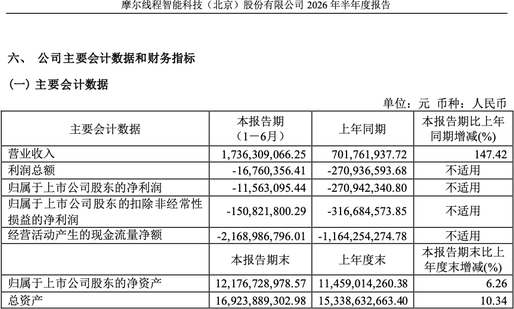
The numbers explain the timing. Since the Shanghai debut, the stock is up more than 420%, and the first-half results support the run. H1 2026 revenue was RMB 1.736 billion, up 147.42% year over year. Net loss attributable to shareholders narrowed to RMB 11.6 million from RMB 270.9 million — a 95.7% reduction. R&D spending came in at RMB 769.1 million.
Revenue up two and a half times while losses all but vanish means this company is crossing from R&D phase into commercial phase. The share price has already priced that expectation, and management is moving to raise again in Hong Kong while the valuation holds.
Plenty of process remains. The issuance ratio is undetermined, and the plan requires shareholder approval plus sign-off from the China Securities Regulatory Commission, the Hong Kong Stock Exchange, and Hong Kong's Securities and Futures Commission. Neither timetable nor offering size is fixed.
What Moore Threads Actually Is
Moore Threads was founded in Beijing in 2020 by a former head of Nvidia's China operations, and a substantial share of its early engineering came from Nvidia as well. Even the name nods to Moore's Law.
It started in gaming graphics — the plan was a domestic GeForce. Then US export controls tightened and the center of gravity moved. When Nvidia was effectively pushed out of China's frontier market, the AI training and inference accelerator demand it left behind opened entirely to domestic designers.
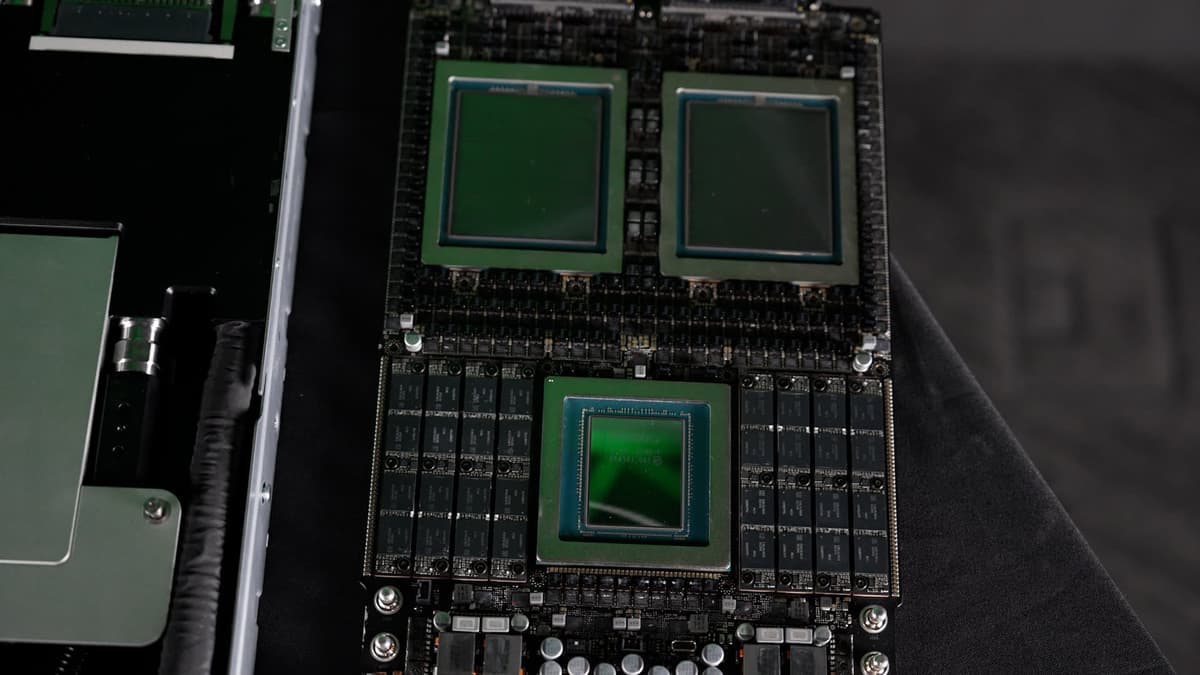
Three companies now compete for that space. Huawei holds the largest volume with its Ascend line, Cambricon is the listed pure-play AI accelerator champion, and Moore Threads chases from a general-purpose GPU architecture. The approaches differ: Huawei is vertically integrated, Cambricon builds dedicated accelerators, Moore Threads is closest to a general GPU. Moore Threads' argument is that a general GPU architecture makes porting existing software ecosystems easier.
One constraint matters above all. None of these chips are fabricated on leading-edge nodes, because equipment export controls cap what Chinese foundries can run. Matching a given performance level therefore takes larger dies and more power. This isn't a head-to-head efficiency contest with Nvidia's Vera Rubin coming out of TSMC. The contest being fought is narrower: is there a usable alternative available inside China?
Why Hong Kong, and Why Now
"A+H" means listing simultaneously on the mainland (A-shares) and in Hong Kong (H-shares). For years it was mostly the province of large state-owned enterprises; it has spread to technology firms recently.
The reason is the nature of the capital. A-shares are domestic money with constraints on foreign participation. Hong Kong is open to international capital and allows raising in Hong Kong and US dollars. Hiring international talent with equity, or standing up offshore subsidiaries, is materially easier from a Hong Kong listing. That's precisely what "deepen international footprint" and "attract talent" translate to in practice.
Market conditions cooperated. As US and European barriers tightened, Chinese tech companies flooded into Hong Kong, and first-time share sales there raised more than $42 billion in 2026 — a six-year high. Walking through an open window is ordinary judgment.
Overlay this with the week's other news and it gets more interesting. On August 10, Nvidia announced $500 billion in compute financing platforms with six Wall Street firms — private credit lent against AI infrastructure as collateral. Chinese companies cannot access that channel at all. So while the US camp raises through private debt, the Chinese camp raises through public equity. Same infrastructure race, completely different plumbing.
| US camp | China camp | |
|---|---|---|
| Primary funding route | Private credit / infra funds (asset-backed) | Public equity markets (A+H) |
| Representative move | Nvidia's $500B financing platforms | Moore Threads' Hong Kong listing |
| Collateral | GPUs, data center cash flows | None — equity dilution |
| Binding constraint | Immature residual value and resale market | No access to leading-edge nodes |
| Scale | $500B+ target | $42B+ raised in HK IPOs in 2026 |
Who Gains What
Moore Threads gains cash and international standing. Chip design costs hundreds of millions per generation — RMB 769.1 million went to R&D in the first half alone — and sustaining that pace requires continuous funding. A Hong Kong listing is both the funding line and a signal that the company operates under international accounting and disclosure standards.
Beijing gains speed on self-sufficiency. Semiconductor independence is national strategy, and financing it through capital markets rather than the treasury scales the industry without fiscal cost. The STAR Market was designed for exactly this, and adding Hong Kong brings international capital into the same effort.
HKEX gains too. As US listings became difficult for Chinese tech firms, Hong Kong has been reclaiming the IPO hub status it lost — the $42 billion figure is the result.
Global investors gain access. A-shares are awkward for foreigners to buy; H-shares are considerably easier. Funds wanting exposure to Chinese AI silicon get a new instrument.
Existing A-share holders absorb the dilution. Issuing new stock after a 420% run is excellent timing for the company and less so for incumbents. That the issuance ratio remains undetermined is the single largest open variable right now.
The Track Record on Dual Listings
A+H is a proven structure, and outcomes have tracked the underlying business.
The success cases are large state enterprises like Air China and ICBC, which raised domestically and internationally at once and absorbed international accounting and disclosure practice through the Hong Kong leg. The governance improvement was a real, observable side effect.
On the technology side, BYD is the closer comparison. Listed in both Hong Kong and Shenzhen, it used both markets to fund an EV business through its scaling phase — domestic demand to build volume, international capital to fund expansion. That's roughly the shape Moore Threads is drawing.
The cautionary case is SMIC. China's largest foundry was listed in Hong Kong and raised substantially through an additional STAR Market listing in 2020. Shortly after, US sanctions closed off leading-edge equipment, and there were suddenly things the money couldn't buy. Capital doesn't lift a ceiling imposed by technology access.
The same risk applies here. Money raised in Hong Kong can fund better chip designs; whether those designs can be volume-produced on a leading-edge node is a separate question entirely. And while 147% growth is striking, the absolute scale is around RMB 1.7 billion — roughly $240 million. TSMC booked $14.5 billion in the single month of July. The order of magnitude is worth holding in mind.
How Rivals Push Back
Huawei isn't playing the fundraising game. It's private, and it runs Ascend on internal cash flow and state backing. While Moore Threads raises in Hong Kong, Huawei can simply push volume with resources it already has. It also sits at the sharpest end of sanctions, making component and equipment sourcing hardest of anyone.
Cambricon is the most direct listing competitor. Already highly valued on the STAR Market, it gains an incentive to play the same card once Moore Threads pulls in international capital. Expect more Chinese AI chip firms heading for Hong Kong.
Nvidia is effectively a spectator in this market. Regulation pushed it out of China's frontier segment, and Moore Threads' growth is evidence that the vacancy is genuinely being filled by domestic suppliers. Long term, that reads as a market closing permanently — even if controls eased, dislodging an entrenched domestic ecosystem is hard.
Korean semiconductor firms face a two-sided effect. More Chinese AI silicon means more memory demand, but China is also pushing hard on domestic memory. And every increment of Chinese AI infrastructure self-sufficiency subtly shifts Korea's leverage in the global supply chain.
What Actually Changes
If you're an investor, three checkpoints: the issuance ratio (dilution), when regulatory approvals clear, and what the proceeds fund. The third matters most — R&D versus production capacity implies very different growth paths. And factor in that the stock has already run 420%.
If you work in semiconductors, this is a gauge of Chinese GPU ecosystem maturity. Revenue up 2.5x with losses nearly eliminated means product is genuinely selling. The next thing to watch is software stack completeness — specifically how well CUDA-written code ports across.
If you build AI products, there's no direct effect yet. These chips serve the domestic market and trail the frontier on performance. But if you plan to serve users in China, running on domestic accelerators may become unavoidable within a few years.
If you follow policy, this is data for re-evaluating export controls. The controls succeeded at slowing China's access to the leading edge, and simultaneously created a protected market for domestic substitutes. Moore Threads' 147% growth measures that side effect. Given how small the absolute base still is, though, declaring the controls a failure would also be premature.
🥄 Three Things You're Probably Wondering
— So what does this mean for me? Nothing directly. It matters as a signal that the AI silicon market is bifurcating into US and Chinese camps — and when even the funding mechanisms diverge, the two ecosystems start growing at genuinely different rates.
— Is Moore Threads becoming an Nvidia alternative? Partly, inside China. Not outside it. Without leading-edge nodes there's a real gap in performance and power efficiency, and the software ecosystem is shallow next to CUDA. The companies it's actually racing are Huawei and Cambricon.
— Is listing again eight months later normal? It's not unusual for Chinese companies. A-shares and H-shares are separate capital pools, so dual listing can be a genuinely purposeful move. But with the issuance ratio unset and approvals outstanding, how much gets raised and when is too early to call.
Further Reading
- Moore Threads plans H-share issue and HKEX Main Board listing (Securities Times / 证券时报) — the primary source, covering the August 7 board resolution, the approval chain, and the undetermined issuance ratio.
- Moore Threads H1 revenue up 147%, plans Hong Kong listing (Sina Finance / 新浪财经) — detail on H1 revenue of RMB 1.736 billion, the narrowed loss, and R&D spending.
- China AI Chip Designer Moore Threads Plans Hong Kong Listing (Bloomberg, 2026-08-09) — the 420% post-IPO gain and the Hong Kong listing environment.
- China GPU maker Moore Threads plans Hong Kong listing after H1 revenue jumps 147% (TechNode, 2026-08-10) — cross-check on the 147.42% revenue figure, the RMB 11.6 million loss, and RMB 769.1 million in R&D.
- Moore Threads plans Hong Kong listing after posting 147% jump in first-half revenue (SCMP) — the competitive picture against Huawei and Cambricon, and the Nvidia vacancy.
- Moore Threads Plans Hong Kong Listing to Fuel AI Chip Push (Caixin Global) — the listing viewed from inside China's capital markets.
Numbers and criteria are as of announcement and may change. Investment calls are yours to make!