OpenAI Just Stepped Into the "Aggregator + AI" Sweet Spot of Fintech
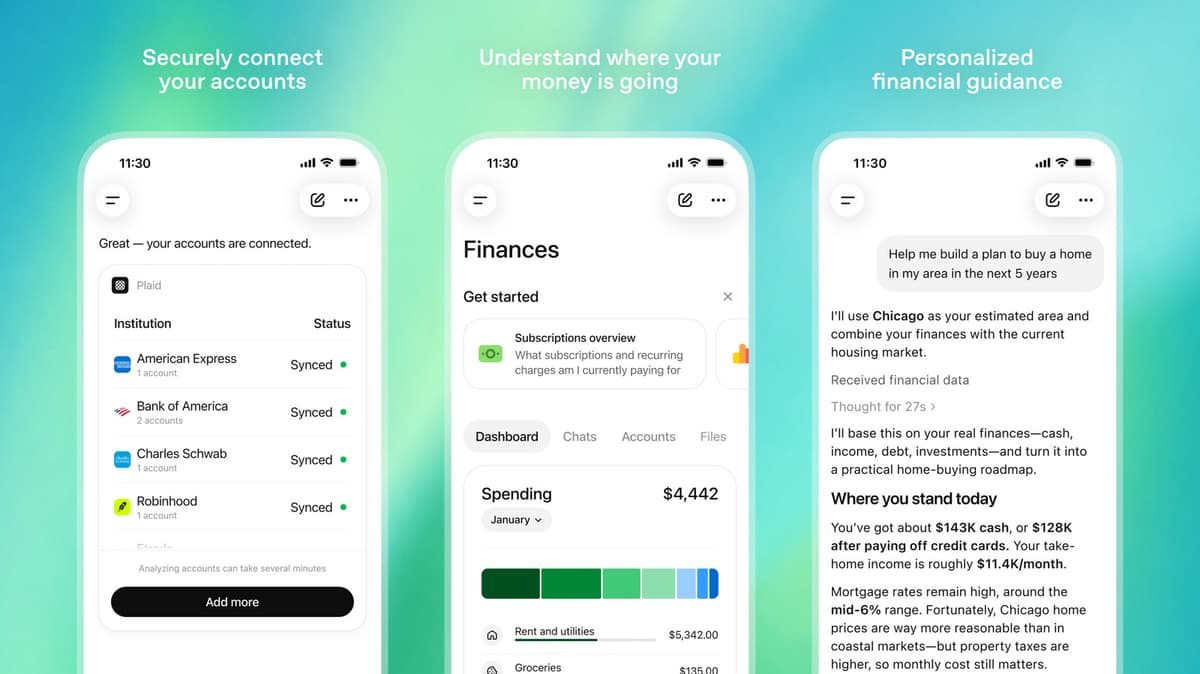
Here's the deal: on May 15, OpenAI launched personal finance tools in preview for U.S. ChatGPT Pro subscribers on web and iOS. Via a Plaid partnership, it can connect to 12,000+ financial institutions — Schwab, Fidelity, Chase, Robinhood, Amex, Capital One — and read balances, transactions, investments, and liabilities to act as your AI financial advisor. Powered by GPT-5.5. Intuit (TurboTax + QuickBooks) support is coming.
The bigger message is market entry. The era of "account aggregator + financial advice" fintechs — Mint (acquired 2009, sunset 2024), NerdWallet, Personal Capital (now Empower), Credit Karma — is in its sunset chapter. Their 10-15 years of building AI recommendation engines just got compressed into a natural-language interface inside ChatGPT. From the user's seat, "connect every account, then ask ChatGPT" feels more natural than "open the Mint app and get recommendations."
The hard constraint is read-only. ChatGPT can read balances, transactions, investments, and liabilities, but cannot move money — no transfers, no buys, no sells. That's (a) security caution, (b) regulatory dodge (money movement requires broker-dealer licensing), (c) Plaid's read-only API surface. Write access for specific use cases (rebalancing, bill pay) is plausible within 12-24 months.
Timing is part of OpenAI's May campaign. After the May 11 $4B Deployment Company and the May 14-15 Codex blast, this May 15 launch is the third punch. OpenAI's positioning: "We are the user's work agent + life agent." Expect healthcare, education, and travel personal tools to follow next quarter.
The Players — ChatGPT Pro, Plaid, and the Fintech Aggregator Market
OpenAI ChatGPT Pro. Launched December 2024 as the top ChatGPT SKU at $200/month. Unlimited GPT-5.5 + advanced reasoning + Codex integration + (as of May 15) personal finance tools. U.S. subscribers only. User count undisclosed; estimated 2-3M.
Plaid. Founded 2013 in San Francisco. API integrations with 12,000+ U.S. financial institutions — the "fintech aggregator infrastructure." Visa tried to acquire for $5.3B in 2020 but the U.S. DOJ blocked it on antitrust grounds. 2026 valuation estimated at $13B+. CEO Zach Perret. Revenue comes from (a) APIs for fintech companies (Robinhood, Venmo, Coinbase, Affirm, etc.), (b) transaction-data normalization, (c) credit/income verification. 2025 revenue estimated at $800M-$1B.
Connected institutions. Plaid integrates 12,000+ institutions. Categories: (a) banks (Chase, Bank of America, Wells Fargo, Capital One, Citi, US Bank), (b) brokerages (Schwab, Fidelity, Vanguard, E*Trade, Robinhood, Webull), (c) credit cards (Amex, Discover, Chase Sapphire), (d) loans (Sallie Mae, Navient), (e) crypto (Coinbase, Kraken). Effectively, 99%+ of U.S. adults can connect their financial accounts to ChatGPT.
Competing aggregators. Mint (acquired by Intuit 2009, sunset 2024) → Credit Karma (Intuit acquired 2020 for $8B, still active) → NerdWallet (public, ~$800M cap) → Personal Capital/Empower (acquired 2020 for $1B, now "Empower Personal Wealth") → Monarch Money (absorbed Mint users post-sunset). ChatGPT entry threatens all of them.
Intuit (TurboTax, QuickBooks, Credit Karma). Notably, OpenAI says "Intuit support coming." Intuit is shipping its own "Intuit Assist" AI — competition + collaboration with OpenAI simultaneously. Intuit market cap ~$180B (Q1 2026). TurboTax has ~40M users. ChatGPT integration would create a two-way TurboTax ↔ ChatGPT data flow.
Sam Altman and fintech ambition. Altman runs Worldcoin (World ID + WLD token), Helion (fusion), and others. ChatGPT personal finance is plausibly a stepping stone toward "OpenAI as a financial services provider." Within 1-2 years, OpenAI could plausibly acquire payments and money-movement licenses.
What It Does, What It Reads, What Secures It
Connection flow. User enables "personal finance" mode inside ChatGPT → Plaid OAuth login to financial institutions → ChatGPT gets read-only tokens. Data flow: user → Plaid → OpenAI servers. OpenAI states "data is fetched live via Plaid tokens; not persistently stored on OpenAI servers" — but conversation context retains data for a session.
Use cases. (a) Asset summary — "What's my total net worth?", "How much is in each account?". (b) Budget analysis — "How much did I spend on food this month?", "Which categories grew vs. last year?". (c) Investment analysis — "Is my portfolio balanced?", "Tesla is too heavy — what should I do?". (d) Debt management — "Which debt should I pay off first?". (e) Goal tracking — "How much do I need to save to retire at 60?", "How long until I have a down payment?". (f) Tax estimation — "What are my capital gains this year?", "Did I max my 401(k)?". Future (when write access opens): "Help me move assets from Schwab to Vanguard."
Security and privacy. (a) Read-only — no money movement. (b) MFA required at Plaid step. (c) Tokens expire (90-day reauth). (d) Per-institution opt-in. (e) No persistent storage at OpenAI (session caching only). (f) GDPR/CCPA-compliant deletion. (g) Audit logs accessible to users. Core concern: AI hallucination on financial advice.
Regulatory posture. OpenAI states "ChatGPT is not a fiduciary; we provide general information." No RIA (Registered Investment Adviser) or broker-dealer registration. ToS includes "no guarantee on AI advice." Litigation risk on user losses remains.
| Area | ChatGPT personal finance | Existing aggregators | Differentiator |
|---|---|---|---|
| Interface | Natural language | Dashboards + charts + alerts | ChatGPT wins on NL |
| Data source | Plaid (12,000+) | Plaid (12,000+) | Same |
| Pricing | Included in $200/mo Pro | Mint free / NerdWallet free / Empower AUM | ChatGPT pricier |
| Money movement | No (read-only) | Some (Empower) | ChatGPT restricted |
| AI recommendations | GPT-5.5 natural language | Proprietary engines | ChatGPT stronger |
| US-only | US first | US + some global | ChatGPT phased |
| Asset-management license | None | Some (Empower = RIA) | ChatGPT info-only |
Fintech market impact. Mint sunset in 2024. NerdWallet (search-ad business model) is directly threatened by ChatGPT entry. Empower (formerly Personal Capital) has the human-advisor + AUM-license moat, partially insulated. Monarch Money and others face the "ChatGPT integration vs. niche differentiation" fork. A wholesale reshape of personal-finance fintech is on a 12-24 month clock.
What Each Side Gets
OpenAI's wins. First, ChatGPT Pro value reinforcement. $200/month is more defensible with "GPT-5.5 + Codex + personal finance." Pro conversion accelerates. Second, user lock-in. Once all accounts are connected, switching cost is real. Third, data flywheel. Even with "no persistent storage," user financial behavior patterns inform future product surfaces. Fourth, on-ramp to financial services. Within 12-24 months, "ChatGPT bank account / transfer / investment account" become plausible.
Plaid's wins. Big. Largest use case for the 12,000+ integration set is now ChatGPT. API call volume jumps 2-3×. Revenue accelerates. Plaid's "fintech infrastructure" positioning solidifies. Pressure on IPO valuation (expected 2027). Visa's 2020 $5.3B offer → potential $20B+ at IPO.
Schwab, Fidelity, Chase, Robinhood, others. Neutral. ChatGPT enhances UX over their data = better retention. But if ChatGPT recommends "move from Schwab to Fidelity," some institutions lose. The key: simultaneous competition with their own AI offerings (e.g., Schwab Intelligent Portfolios).
Mint, NerdWallet, Empower. Direct threat. Mint already sunset (2024). NerdWallet's search-ad business model erodes as ChatGPT becomes the entry point. Empower's human-advisor moat partially insulates. Monarch and similar startups need to either integrate GPT-5.5 or niche down (couples finance, freelancers, military).
Intuit (TurboTax + QuickBooks + Credit Karma). Awkward. ChatGPT integration is coming → user value goes up. But it competes with Intuit Assist AI. Watch the next 12-24 months for Intuit's $180B market cap. Credit Karma's 250M+ user base × ChatGPT is the swing variable.
Human financial advisors. Mixed. Loss on commoditized questions (ChatGPT free or near-free). Gain on complex estate planning, tax optimization, and high-net-worth wealth management. Advisors move up the value chain to "AI-augmented high-touch."
End users. Big win. Pricey at $200/mo, but the natural-language layer across all accounts is convincing. Differentiators vs. Mint/NerdWallet free: (a) GPT-5.5 natural-language fidelity, (b) Codex integration (e.g., automated bill-pay scripts), (c) synergy with other ChatGPT capabilities.
Regulators (SEC, FINRA, CFPB). New territory. Whether AI financial advice falls under "investment adviser" definition needs clarification within 12-24 months. Possible outcomes: (a) separate AI-financial-advice license, (b) RIA registration mandate for AI companies, (c) heightened user-protection standards.
Historical Parallels — Wins and Losses
Win: Mint (2006-2024). Founded by Aaron Patzer in 2006, acquired by Intuit for $170M in 2009. Reached ~25M users. Set the standard for "aggregator + budgeting." Intuit folded Mint into Credit Karma in 2024. User base partially absorbed by Monarch Money. Lesson — aggregator UX is valuable, but monetization is weak. ChatGPT solves with a $200/month subscription.
Win: Personal Capital → Empower (2009-). Founded by Bill Harris (ex-PayPal CEO) in 2009. "Aggregator + human advisor" model. Acquired by Empower Retirement for $1B in 2020. ~$600B AUM today. Differentiator: human advice + asset-management license. ChatGPT eats into human-advice volume, but the license matters — Empower is partially insulated.
Partial loss: Yodlee (1999-). Pioneered fintech aggregation, acquired by Envestnet for $590M in 2015. Pivoted to "B2B data provider" but lost ground to Plaid. Lesson — aggregators must choose B2C UX or B2B infrastructure. ChatGPT + Plaid captures both.
Loss: Apple's post-Apple-Pay fintech ambitions (2014-). Apple Card, Apple Savings, Apple Cash. Big user base, modest revenue. In 2024, Apple effectively wound down the Goldman Apple Card partnership. Lesson — big tech in fintech is more about ecosystem lock-in than revenue. OpenAI follows the same pattern; ChatGPT user lock-in is the goal.
Competitor Counter-Plays
Google. "Google Finance + Google Pay + Gemini" bundle is plausible. Google sunset Mint in 2024 and beefed up Google Finance. Integration with Google Pay enables "balance + AI advice." Differentiation via Pixel Studio + Workspace. Watch Google I/O 2026 (May 19).
Anthropic Claude. "Cowork + personal finance" extension is the natural counter. Anthropic has stronger global presence — Plaid is U.S.-centric, but UK/EU equivalents (Tink, TrueLayer) are partners. Differentiator: "AI safety" framing. Expect a follow-on launch within 6-12 months.
Meta. "WhatsApp + Instagram + Meta AI personal finance" possible, but Meta lacks the fintech licensing groundwork. Short-term counter is hard.
Apple. "Apple Pay + Apple Card + Apple Cash + Apple Wallet + AI" possible. iOS 27 (late 2026) could include "Apple Intelligence Finance." Differentiators: Apple Watch + iPhone Face ID strong-authentication. But behind ChatGPT.
Intuit. Strengthen Intuit Assist + leverage Credit Karma's 250M-user base + deep TurboTax data integration. OpenAI's "Intuit support coming" signals collaboration + competition simultaneously.
Fintech startups (Monarch, Copilot Money, Quicken Simplifi). Direct threat. Counters: (a) Price-or-UX differentiation vs. ChatGPT, (b) niche down (couples, self-employed, military), (c) integrate GPT-5.5 API directly. Monarch already has 500K+ users.
Chinese big tech (Alipay, WeChat Pay). Domestic market shielding + DeepSeek-style AI integration blocks ChatGPT entry. Alipay launches "AI personal finance assistant." Globally, U.S. players still lead.
So What Actually Changes — by Persona
Pro subscribers (U.S.). Big win. $200/mo justification strengthens. Recommendations: (a) connect all accounts, (b) start with "what's my asset mix?" type questions, (c) keep estate planning with human advisors.
Non-U.S. ChatGPT users. No effect for now. U.S.-first launch; global expansion in 6-12 months.
Financial advisors (U.S.). Mixed. Routine-question automation threatens commodity work. Recommendations: (a) move up the value chain (AI-augmented high-touch), (b) use ChatGPT to lift your own efficiency, (c) strengthen estate planning, tax optimization, business advisory.
Fintech founders. Big threat. Counters: (a) match the value at a price-or-UX advantage that doesn't depend on ChatGPT, (b) niche down (couples, freelancers, military), (c) integrate GPT-5.5 directly. Monarch's 6-12 month response is the one to watch.
Banks and brokerages. Mixed. Trade-off between in-house AI tools and ChatGPT integration. Schwab can offer both Schwab Intelligent Portfolios + ChatGPT integration. Digital-strong players (Robinhood, Fidelity) play "ChatGPT integration card." Traditional banks (Chase, BoA) accelerate in-house AI.
Regulators (SEC, FINRA, CFPB). New work. "AI financial advice = investment adviser?" determination needed. Guidelines likely within 6-12 months. OpenAI may end up needing RIA registration in some scenarios.
Users (Korea, OECD). No direct effect. Indirect: (a) pressure on Korean fintechs (Toss, Kakao Pay) to integrate ChatGPT, (b) faster Tink/TrueLayer integration with ChatGPT in UK/EU, (c) Open Banking standardization pressure in Japan and Korea.
Investors. Direct exposure — OpenAI rounds (if accessible), Plaid follow-ons or IPO, Intuit. Indirect — Monarch and similar startups pivoting to "ChatGPT integration" stories may see funding momentum.
References
- OpenAI — Personal finance ChatGPT (2026-05-15)
- TechCrunch — OpenAI launches ChatGPT for personal finance
- Engadget — ChatGPT personalized financial advice if you connect your bank
- Plaid press release — OpenAI Partnership 2026
- Mint sunset — Intuit 2024 integration announcement
- Empower Personal Wealth (formerly Personal Capital)
- spoonai 2026-05-17: OpenAI Codex broad expansion (today)